Chronic venous disease spans a wide range—from spider veins and varicose veins to swelling, skin change, and open ulceration in the leg. An international framework is used so clinicians record the same finding in the same terms: CEAP. The name comes from the initials of four English headings; their meanings are clinical, aetiology (cause), anatomy, and pathophysiology (mechanism).
The framework grew from American Venous Forum work in the 1990s, was revised in 2004, and updated in 2020. The European Society for Vascular Surgery 2022 guideline also uses this classification to describe chronic venous disease.
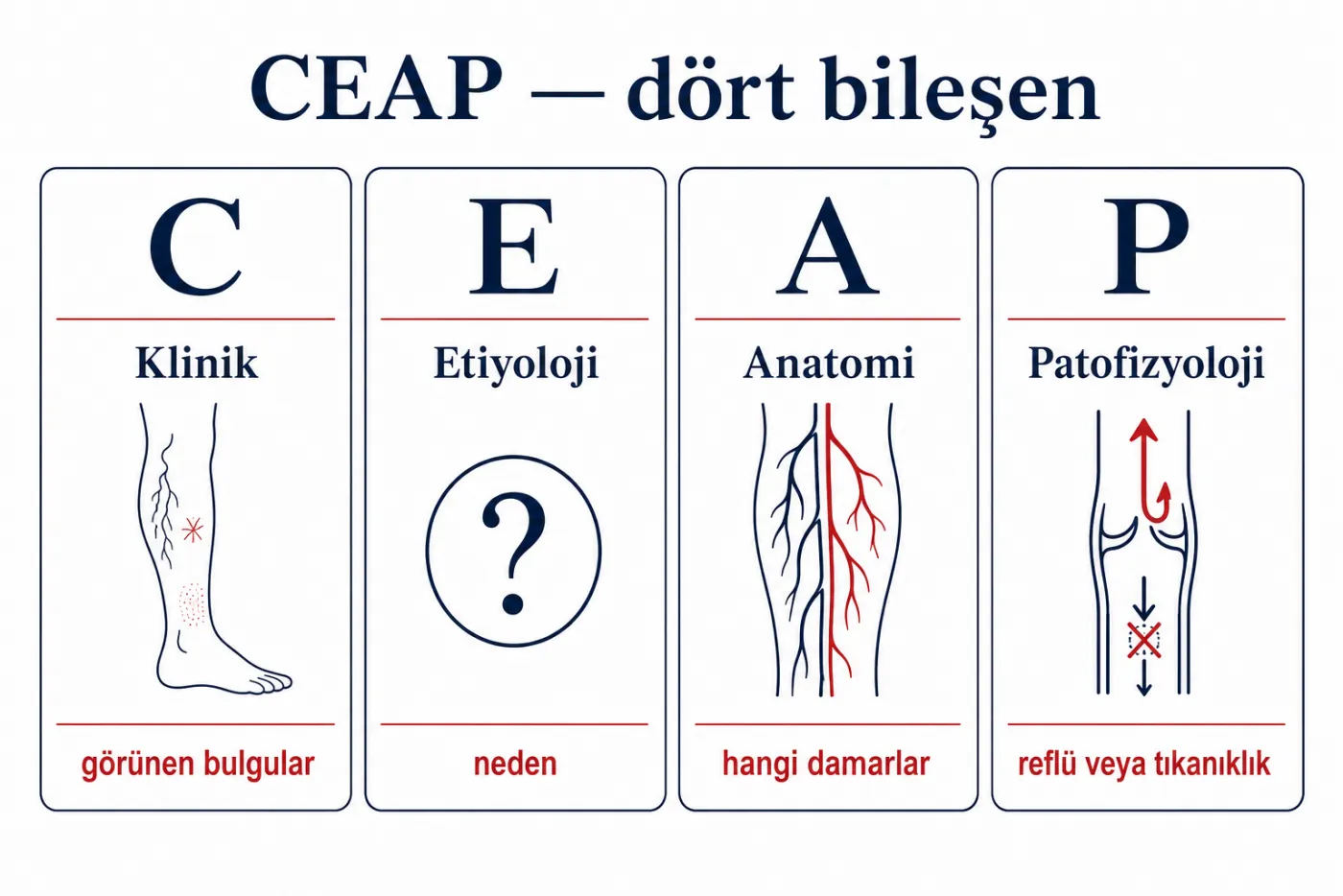
What do the four components describe?
- Clinical: Findings seen on inspection or felt on examination (for example varicose veins, oedema, ulcer).
- Aetiology: The cause of disease — congenital, primary, or secondary (for example after prior venous thrombosis).
- Anatomy: Whether the problem involves superficial, deep, or perforating veins.
- Pathophysiology: The core mechanism — reflux, obstruction, or both together.
In daily practice most records start with the clinical class (C0–C6). A full CEAP record also states cause, vessel location, and mechanism alongside the clinical class.
Clinical classes: from C0 to C6
A summary of the clinical classes according to the 2020 update appears below. For a single limb, the most advanced (highest) class is usually reported. In a detailed record, more than one class on the same limb may be listed together. For each class, whether the patient is symptomatic or asymptomatic can also be noted.
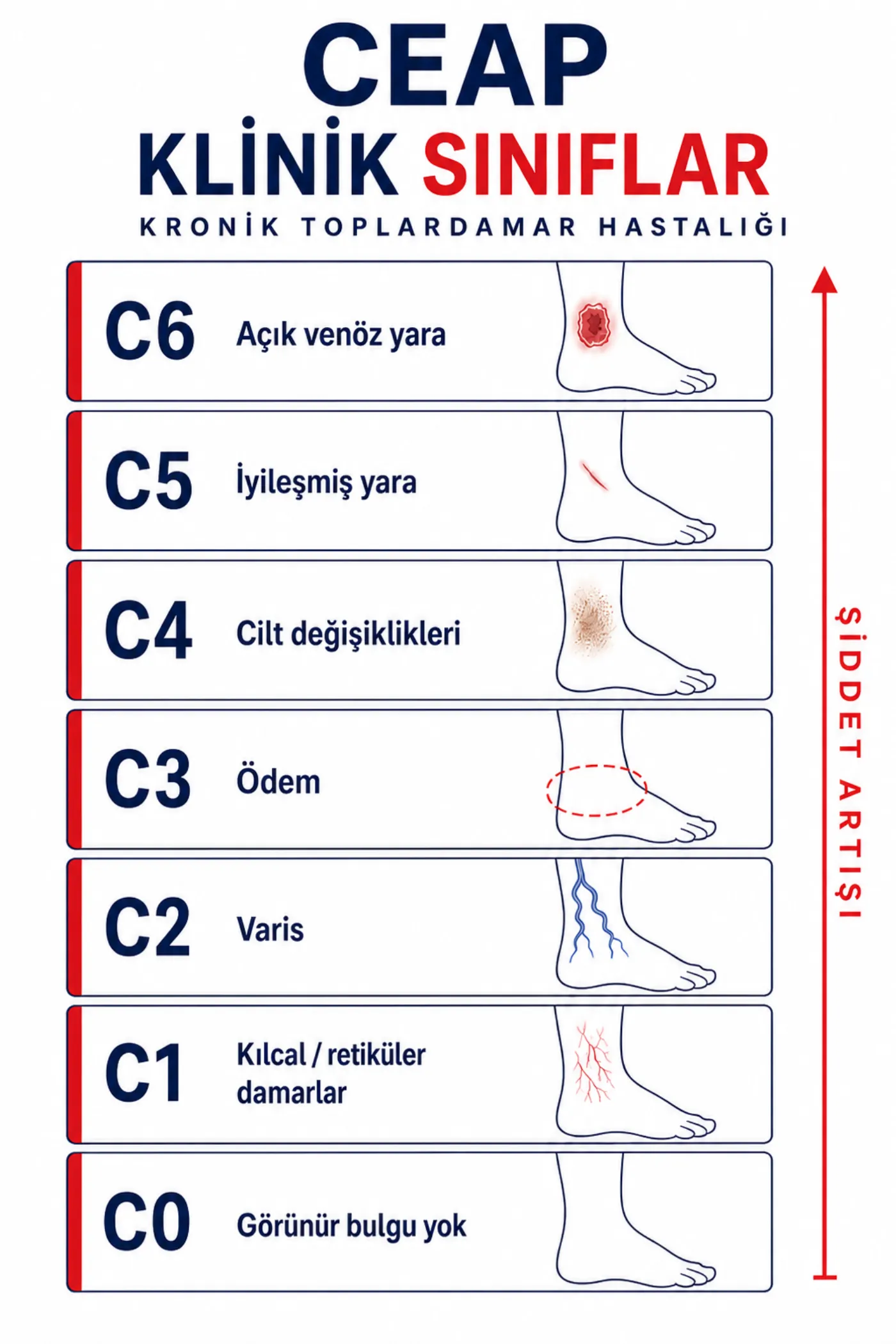
- C0 — No visible or palpable venous finding.
- C1 — Telangiectasias or a fine reticular vein network visible under the skin.
- C2 — Varicose veins (usually 3 mm or more). Recurrent varicose veins may be noted as C2r.
- C3 — Oedema (swelling).
- C4 — Skin and subcutaneous changes related to venous disease:
- C4a — Pigmentation or eczema
- C4b — Subcutaneous hardening (lipodermatosclerosis) or white atrophy (atrophie blanche)
- C4c — Corona phlebectatica — a fan-shaped network of small veins around the ankle
- C5 — Healed venous ulcer.
- C6 — Open (active) venous ulcer. Recurrent open ulcer may be noted as C6r.
Why does it matter?
CEAP provides common terminology for physicians, nurses, and clinical studies. When compression, intervention or wound care is being planned, it defines the clinical class of the presentation. Classification alone does not choose treatment; it organises assessment.
For product categories, see compression; for dressings, see wound care. For patient information, see Dr. Kadir Çeviker’s articles on chronic venous insufficiency and varicose veins.
Sources
- Lurie F, et al. The 2020 update of the CEAP classification system and reporting standards. J Vasc Surg Venous Lymphat Disord. 2020;8(3):342–352. DOI: 10.1016/j.jvsv.2019.12.075 · PubMed 32113854
- De Maeseneer MG, et al. European Society for Vascular Surgery 2022 Clinical Practice Guidelines on the Management of Chronic Venous Disease of the Lower Limbs. DOI: 10.1016/j.ejvs.2021.12.024 · PubMed 35122636
- StatPearls / NCBI. CEAP Classification of Venous Disorders
- VascularVita — Compression