
Product line
Stem cell & exosome
Category-level regenerative product groups for institutional technical review—source, characterisation and logistics read together.
Product line
Cellular communication and repair products
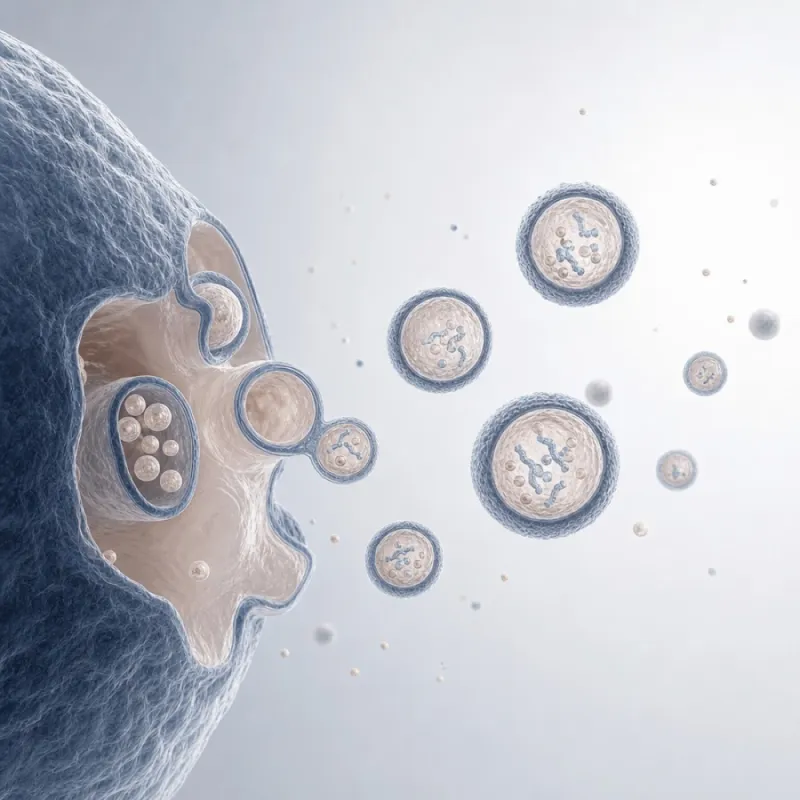
Exosomes are small vesicles secreted by cells; they carry proteins, lipids and genetic material and participate in intercellular communication. VascularVita works with institutions to assess technical files, quality certificates and supply conditions across exosome, platelet-rich plasma (PRP), cytokine, stromal vascular fraction (SVF) and cellular product groups.
What does it describe?
Cells communicate not only through direct contact but also through the vesicles they secrete. Exosomes are one form of this communication under study.
How is it supplied?
Product selection, technical documentation and delivery conditions are planned with your institution. The application decision rests with the physician and the institutional protocol.
Essential information
What is an exosome?
Exosomes are extracellular vesicles (EV) approximately 30–150 nanometres in diameter. Their contents vary according to source-cell type, culture conditions and separation method. EV is the umbrella term used in scientific reporting.
How is it formed?
A cell packages some of its molecules into small membrane-bound vesicles and releases them. A target cell can take up this package or interact with its surface.
What does it carry?
Proteins, lipids, growth factors and nucleic acids. The cargo depends on the cell from which it is produced and the manufacturing process.
How is it characterised?
Size distribution, surface markers, purity and functional profile are measured. The international reporting framework is listed in the sources section.
What does the technical file contain?
Source cell, manufacturing and purification method, particle count, sterility, endotoxin and mycoplasma results, and storage and transport conditions.
Scientific basis
Biological pathways examined in research
Research on exosomes and extracellular vesicles focuses on immune responses, vascular biology, cell behaviour and extracellular matrix regulation. Findings cannot be transferred directly between products; the source cell, manufacturing method, dose and study model affect the result.
Immune regulation
Interactions between extracellular vesicles, inflammatory cells and cytokine balance are examined in experimental and preclinical studies.
Blood vessel formation
Signals delivered to endothelial cells and new blood vessel formation (angiogenesis) are among the principal mechanistic areas in tissue-repair research.
Cell migration and proliferation
The relationship between transported proteins and nucleic acids and target-cell migration, proliferation and tissue response is investigated in different models.
Matrix and fibrosis
Extracellular matrix turnover and fibrotic signalling pathways are also investigated in liver, lung and skin models.
Product scope
Which groups are available?
The product line comprises four groups. Select the relevant product for detailed technical information and contact.
Product group
Exosome
Vials containing extracellular vesicles obtained from cell culture. Four options are available by volume and minimum particle level.
Product group
Platelet-rich plasma
Single-use sets and components used to prepare platelet-rich plasma from the patient's own blood.
Product group
Cytokines and growth factors
Clinical-grade preparations manufactured to defined purity and biological activity values. Each batch is delivered with its own certificate of analysis.
Product group
SVF and cellular products
Processing products for obtaining stromal vascular fraction (SVF) from adipose tissue, together with cellular product supply. The scope is agreed with the institution in accordance with current regulations.
Documents supplied with delivery
Each shipment includes the product specification, the certificate of analysis for the relevant lot and the transport record. The lot number and expiry date on the label correspond to the information in the documents.
Technical supply file
Product specifications and quality records
The content, technical specifications and quality records supplied at delivery for each item are set out below. Select the product name for detailed technical information and contact.
Exosome product options
Vials containing extracellular vesicles are available in four options by volume and minimum particle level. The technical file for each option sets out the source cell, manufacturing method and lot analysis.
-
Exosome · 2 mL · ≥5 billion particles
- Form
- Vial · 2 mL
- Content level
- At least 5 billion extracellular vesicle particles
- Lot analysis
- Particle count and size distribution
- Safety
- Sterility, endotoxin and mycoplasma tests
-
Exosome · 5 mL · ≥5 billion particles
- Form
- Vial · 5 mL
- Content level
- At least 5 billion extracellular vesicle particles
- Lot analysis
- Source cell, isolation method and surface markers
- Storage
- Freezer temperature; shipment in a validated transport container
-
Exosome · 5 mL · ≥50 billion particles
- Form
- Vial · 5 mL
- Content level
- At least 50 billion extracellular vesicle particles
- Lot analysis
- Particle concentration, size distribution and identity markers
- Traceability
- Unique verification code, lot number and expiry date
-
Exosome · 5 mL · ≥100 billion particles
- Form
- Vial · 5 mL
- Content level
- At least 100 billion extracellular vesicle particles
- Lot analysis
- Concentration, purity and batch-to-batch consistency
- Document
- Lot-specific certificate of analysis and storage conditions
Platelet-rich plasma preparation systems
Sets and components used to prepare platelet-rich plasma (PRP) from the patient's own blood. The resulting platelet dose varies according to blood volume, centrifugation protocol and the set used.
-
Closed-system PRP preparation set
- System
- Closed set for blood collection, separation and transfer
- Product output
- Total platelet dose and leucocyte and erythrocyte proportions
- Protocol
- Blood volume, anticoagulant, centrifugation force and duration
- Document
- Sterile and single-use; lot number and expiry date
-
PRP separation and transfer components
- Scope
- Separation and controlled-transfer components
- Compatibility
- Set material, connection type, anticoagulant and device compatibility
- Selection
- Target leucocyte profile and platelet recovery
- Traceability
- Set lot number and procedure record
Cytokines, growth factors and cellular products
Clinical-grade cytokine and growth-factor preparations and cellular products. Identity, purity, activity and safety results are reported for each item on a lot-specific basis.
-
Clinical-grade cytokine and growth factor
- Identity
- Product-specific analytical method and reference standard
- Purity
- Purity ratio; residual host-cell protein and DNA
- Activity
- Biological activity (potency) result and test method
- Safety
- Sterility, endotoxin, mycoplasma and source-material safety
- Document
- Lot-specific certificate of analysis, shelf life and storage conditions
-
- Source and process
- Adipose tissue; enzymatic or mechanical processing in a closed system
- Cell profile
- Total nucleated-cell count, viability and surface markers
- Purity
- Proportion of unwanted cells, tissue debris and process residues
- Safety
- Sterility and endotoxin; mycoplasma according to process risk
- Regulation
- Product and procedure scope is planned in accordance with current regulations
-
Cellular product technical file
- Identity
- Source tissue and immunophenotypic characterisation
- Quality
- Viability, purity, cell count and batch-to-batch consistency
- Potency
- Validated test method linked to the intended biological function
- Microbiology
- Sterility, mycoplasma, endotoxin and viral safety
- Delivery
- Release approval, transport conditions and delivery record
Cold chain and delivery
Temperature-sensitive products are dispatched at the manufacturer's specified storage temperature in a validated transport container. The temperature record accompanies the shipment; the product label and documents are cross-checked on delivery.
Related pages
Further reading
The healthy-lifespan framework and the wound-care product line intersect with this subject. For patient information, see Dr Kadir Çeviker's article, What exosomes are and are not.
Sources
Scientific basis
Principal regulatory and scientific frameworks for product characterisation, manufacturing, quality control and reporting.
- Turkish Medicines and Medical Devices Agency — Manufacturing and quality requirements for human-derived tissue and cell products and advanced therapy medicinal products, 2026
- International Society for Extracellular Vesicles (ISEV) — Minimal Information for Studies of Extracellular Vesicles 2023 (MISEV2023) reporting framework
- Welsh et al. — MISEV2023, Journal of Extracellular Vesicles, 2024
- Murray et al. — Minimum reporting requirements for studies evaluating PRP and mesenchymal stromal cells
- International Federation for Adipose Therapeutics and Science (IFATS) and International Society for Cell & Gene Therapy (ISCT) — Characterisation of stromal vascular fraction and adipose-derived stromal cells
- Identity, purity, viability, potency and microbiological quality criteria for cellular products
- kadirceviker.com — What exosomes are and are not
- VascularVita — Longevity and healthy ageing
Product and collaboration information
Contact our team regarding technical scope, supply and institutional collaboration.