The calf feels heavy after a night coach or an eight-hour flight. The first steps are stiff, the ankle looks fuller than it did at departure. Most of the time that is only the mark of sitting still. The same immobility can allow a clot to form in a deep vein. Clinicians call this travel-related venous thromboembolism. The popular label “economy class syndrome” misses the point. Seat class is not the cause. Hours without moving are.
Why blood slows in that seat
A venous clot forms easily when three conditions meet: blood flow slows, the vessel lining is injured, and the blood itself becomes more ready to clot. On a long journey, the first of these is the main driver of clotting.
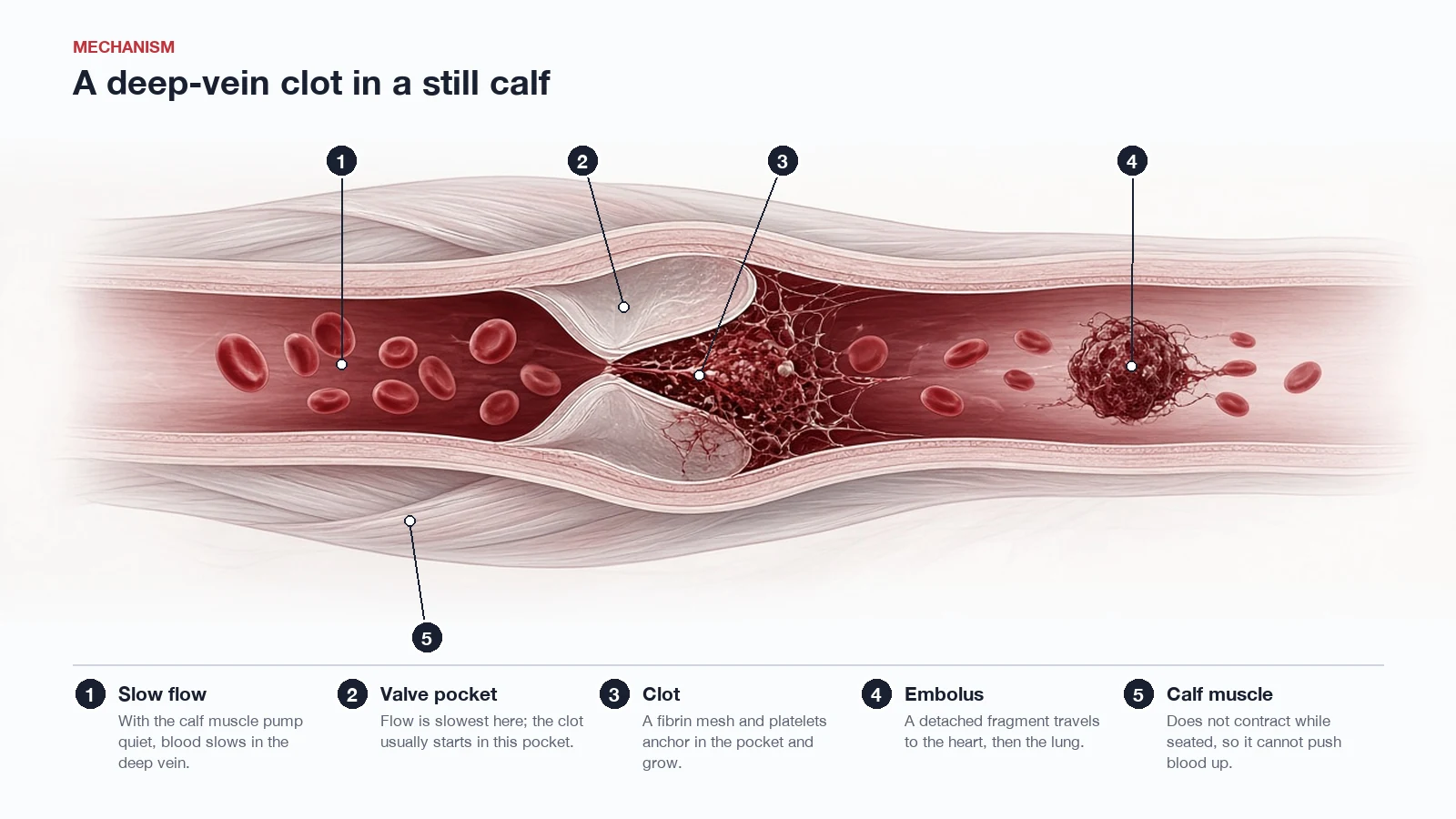
While walking, the calf muscle squeezes and releases, driving blood up the deep veins. That is the calf muscle pump. During long hours in a seat, the pump does not work. A bent knee also narrows the popliteal vein behind the joint. Slower flow leaves clotting factors against the vessel wall for longer. The clot usually starts in the deep veins of the calf. If a fragment reaches the lung, the event is a pulmonary embolism. Together they are venous thromboembolism.
What does the cabin add to a coach seat?
On a coach, a train, or in a car, the ground is stasis. A tight seat, overnight sleep, and too little water add to it. The harder it is to reach the aisle, the longer the calf stays still. A window seat is the less favourable place for that reason: standing up means asking someone else to move, so the traveller postpones it.
A flight adds two physical conditions. Cabin air is dry, so insensible fluid loss rises and the blood becomes relatively more concentrated. Cabin pressure is not room pressure either. In cruise it is held at the equivalent of about 1,800–2,400 metres. Oxygen pressure falls.
The third setting is not only a theory. In healthy volunteers, an 8-hour flight raised the thrombin–antithrombin complex by a median of 30%. The same people, sitting through an 8-hour film, showed no such rise. A strong response was more common when factor V Leiden and an oral contraceptive were present together. Stasis belongs to every long seat. The cabin switches coagulation on, in some people, beyond sitting alone.
Duration has been measured as well. A pooled estimate from 14 studies puts the risk of venous thromboembolism in travellers at about twice that of people who did not travel. Once a bias in how control groups were chosen is set aside, the estimate rises to 2.8. Each extra 2 hours lifts risk by about 18% for any mode of transport, and by about 26% for air. On journeys longer than four hours the risk becomes noticeable; guideline thresholds are often set at more than six hours. A symptomatic clot remains uncommon in a traveller with no added risk. The risk rises from a small base. That does not erase the effect of time.
Who is at higher risk
Guidance gathers the situations that raise risk on a long journey into one list: previous venous thromboembolism, recent surgery or trauma, active cancer, pregnancy, oestrogen use, advanced age, limited mobility, severe obesity, and a known thrombophilia. Varicose veins alone do not carry the same weight as the factors on that list. A leg with chronic venous disease may already have slow venous flow; its stage is described by the CEAP classification, while travel risk is assessed against the person’s own history.
Two risks stacked together change the picture. Coagulation markers after a flight rise more readily in someone who carries factor V Leiden and uses an oral contraceptive. For a traveller recovering from recent hip or knee surgery, a six-hour coach does not mean the same as it does for a healthy passenger. Your doctor can assess that difference before the journey.
Movement, stockings, and medicine do not mean the same thing
The layer that applies to everyone is movement. Walking the aisle each hour, pumping the ankle, and squeezing the calf break up stasis. Water does not do the work of avoiding alcohol; alcohol both dries the traveller and lengthens sleep in the seat. An aisle seat is the better choice because standing up is easier.
Graduated compression is the second layer, and not every passenger may need it. The American College of Chest Physicians (ACCP) suggests below-knee stockings providing 15–30 mmHg at the ankle for travellers at increased risk on journeys longer than six hours. It does not recommend the same stockings routinely when that extra risk is absent, although a Cochrane review found that stockings reduce symptomless deep-vein thrombosis on flights longer than four hours; no deaths, pulmonary emboli, or symptomatic clots were reported in those trials. The benefit shown relates mainly to asymptomatic clots and oedema.
This medical pressure range should not be confused with everyday medical compression stockings. A travel stocking is chosen for journey length and personal risk. The types of compression stocking you may need are on the compression page; a higher-pressure stocking is not better for every traveller.
The third layer is medicine, and it is not routine. ACCP suggests against aspirin or an anticoagulant to prevent clots on long journeys. In a person at particularly high risk, the decision belongs to a physician who can weigh bleeding and the rest of the medicine list. Aspirin is not a stand-in for an anticoagulant here.
After the journey, one-sided calf swelling, warmth, and pain — or sudden breathlessness and chest pain — are not dismissed as travel fatigue. Assessment is clinical. A clot may declare itself within hours, or over the following days.
Sources
- Chandra D, Parisini E, Mozaffarian D. Meta-analysis: travel and risk for venous thromboembolism. Ann Intern Med. 2009;151(3):180-190. doi:10.7326/0003-4819-151-3-200908040-00129
- Schreijer AJM, et al. Activation of coagulation system during air travel: a crossover study. Lancet. 2006;367:832-838. doi:10.1016/S0140-6736(06)68339-6
- Kahn SR, et al. Prevention of VTE in nonsurgical patients. ACCP Evidence-Based Clinical Practice Guidelines, 9th ed. Chest. 2012;141(2 Suppl):e195S-e226S. doi:10.1378/chest.11-2296
- Clarke MJ, et al. Compression stockings for preventing deep vein thrombosis in airline passengers. Cochrane Database Syst Rev. 2021;4:CD004002. doi:10.1002/14651858.CD004002.pub4
- CDC Yellow Book. Deep vein thrombosis and pulmonary embolism. cdc.gov/yellow-book