
In VascularVita longevity work, the aim is not to reverse chronological age. The aim is to protect the years in which a person can walk, decide, and sustain daily life — healthspan. Ageing is not reduced to a single laboratory result. Cellular and molecular decline, organ-system change, a person’s intrinsic capacity and daily function form a single continuum. Management follows from this assessment: define the clinical picture, reduce risk, give indicated treatment and monitor.
At the cellular level, one of the primary drivers in this continuum is telomere attrition. In López-Otín and colleagues’ framework of the hallmarks of aging, telomere attrition is one of the primary hallmarks. Genomic instability describes general DNA maintenance; this article focuses on the chromosome end. All nine hallmarks appear in the nine hallmarks of ageing; the programme is described in the ageing stages and in individual assessment.
What is a telomere?
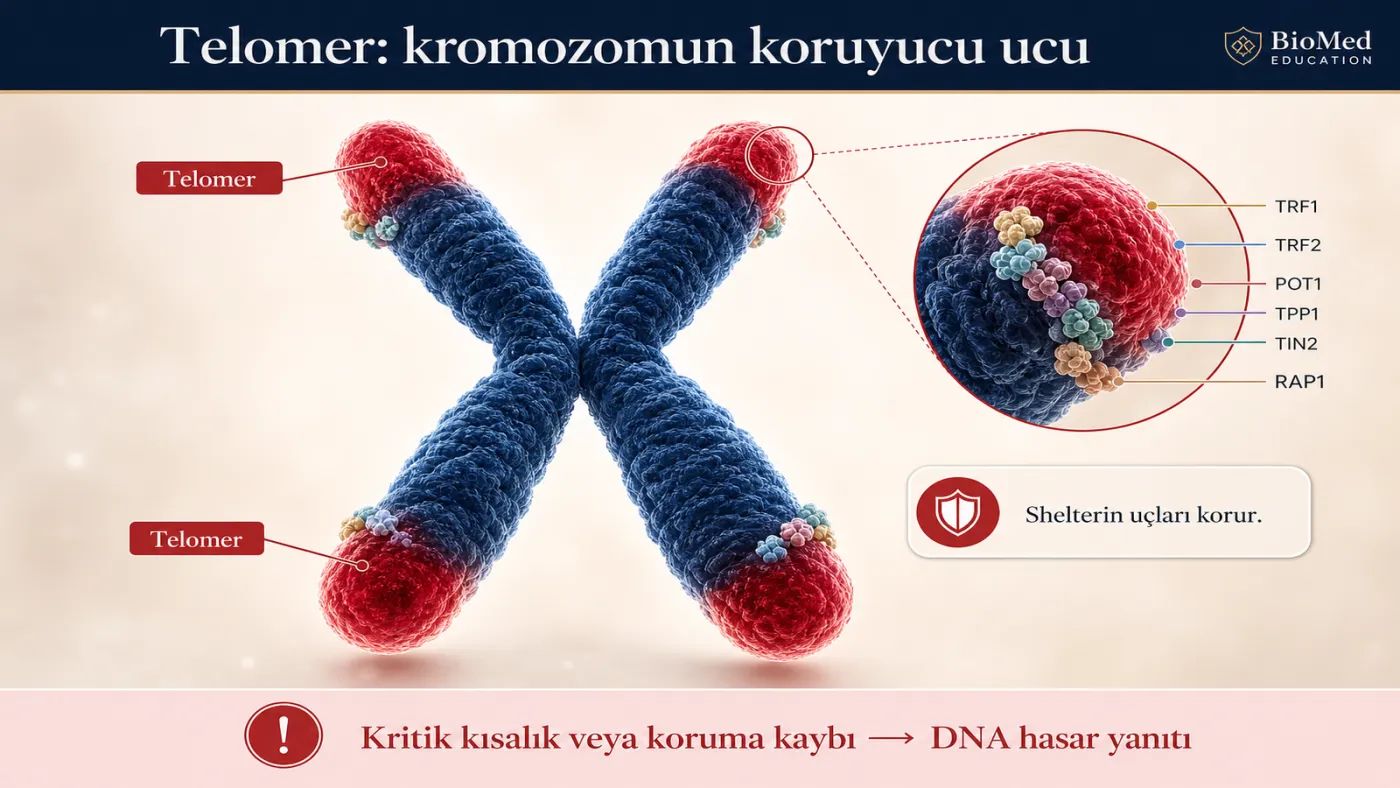
A telomere is the name given to the repetitive structure at the ends of linear chromosomes. In humans the repeat unit is TTAGGG. If the end is recognised as an ordinary double-strand break, the cell initiates the DNA damage response (DDR). The protein set that prevents this is the shelterin complex.
Two concepts must be separated. Telomere length reflects the number of repeats at the chromosome end. Telomere function is whether, together with shelterin, the end is truly protected. Even if length is still adequate, if protection fails the cell can move into a senescent state.
Why do they shorten?
Four motors work together.
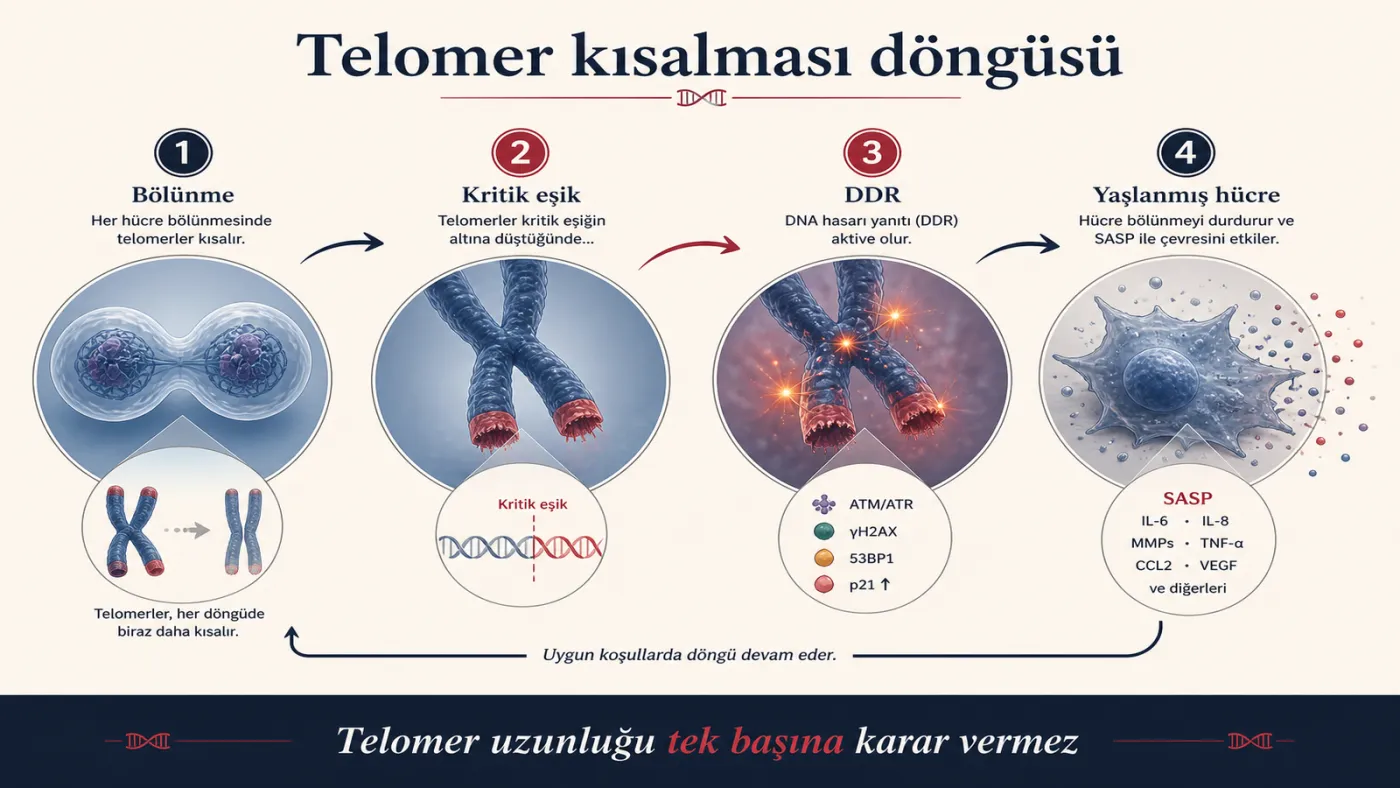
The end-replication problem. The enzymes that copy DNA cannot fully complete a linear end. With each cell division there is a net shortening. This is the molecular face of the classic Hayflick limit.
Oxidative damage. The telomere sequence is sensitive to oxygen-derived species. Even in non-dividing cells, where length may stay the same, a damaged end can generate DDR.
Inflammation and stress. Low-grade chronic inflammation and certain life conditions can increase the rate of shortening.
Heredity. Telomere length at birth is partly genetic; it shapes the lifelong trajectory.
In most somatic cells telomerase is off. Telomerase adds DNA to the telomere via TERT (the catalytic protein) and TERC (the RNA template). Germ cells and some stem cells use this enzyme. Many cancer cells reopen TERT and approach immortality. That is why the idea of “lengthen everyone’s telomeres” and cancer biology share the same machinery.
What does shortening lead to?
Critical shortness or dysfunction triggers the DNA damage response. The cell may become a senescent cell. A senescent cell stops dividing; the substances it secretes sustain inflammation in neighbouring tissue. That secretion is known as the senescence-associated secretory phenotype (SASP). The chain extends to stem-cell reserve and intercellular communication — linking to the antagonistic and integrative layers of the nine-hallmarks framework (López-Otín 2023).
On the human clinical spectrum, extremely short telomeres appear in diseases called telomeropathies: dyskeratosis congenita, some idiopathic pulmonary fibrosis (IPF) presentations, and aplastic anaemia. These are not an “anti-ageing” indication; they belong to disease-specific care (Armanios and Blackburn, 2012).
Measurement: when is it meaningful?
Leukocyte telomere length in blood (LTL: leukocyte telomere length) is associated with age and with certain diseases. The association alone is not a “biological age meter.” Method also changes the result.
When telomeropathy is suspected, the method closest to clinical standard is flow-FISH: interpreted by age-adjusted percentile. qPCR, widely used in epidemiology, has high inter-laboratory variability; it is not suitable for assigning a longevity stage (Alder et al., 2018). In the VascularVita programme, an A–F stage is not assigned from LTL. Early greying, nail–skin findings, a family history of IPF or aplastic anaemia, or unexplained cytopenia require haematology or relevant specialty evaluation.
What is done in management?
In the VascularVita approach, telomere attrition is addressed in three concrete steps.
First is prevention. Stopping tobacco, regular exercise, adequate sleep, and control of blood glucose and weight reduce oxidative load and inflammation. These steps do not claim “we lengthened telomeres”; they protect the environment in which the end is maintained.
Second is disease-guided treatment. Suspicion of telomeropathy or organ disease is referred to specialty care. Diagnoses such as diabetes or hypertension are managed with the relevant guidelines. Longevity screening assesses the ICOPE domains, frailty, and daily function together; it does not assign a stage from a single telomere score.
The third step is monitoring over time. Telomere stress is linked to accumulation of senescent cells and inflammation. That is why attention is not limited to a single blood test. Mobility, energy, cognition, and independence are reassessed at defined intervals. The flow is on the individual assessment and ageing stages pages.
In consumer “telomerase activator” products, leukocyte telomere length may increase in some studies; consistent improvement in frailty and daily function has not been shown. No product-based protocol is offered in this area. Animal studies of TERT restoration have produced healthspan effects; there is no approved path as a human longevity therapy (DePinho, 2026).
Summary
Telomere attrition is a primary hallmark of ageing that emerges as maintenance of chromosome ends becomes harder. When shelterin fails, the chromosome end becomes exposed to the DNA damage response; accumulation of senescent cells and inflammation spread into the tissue. In VascularVita longevity management, this hallmark is addressed through prevention, indicated treatment, and function-focused monitoring; telomere length alone does not decide.
References
- López-Otín C, Blasco MA, Partridge L, Serrano M, Kroemer G. The hallmarks of aging. Cell. 2013;153(6):1194–1217. doi:10.1016/j.cell.2013.05.039 · PMC3836174
- López-Otín C, Blasco MA, Partridge L, Serrano M, Kroemer G. Hallmarks of aging: an expanding universe. Cell. 2023;186(2):243–278. doi:10.1016/j.cell.2022.11.001
- Armanios M, Blackburn EH. The telomere syndromes. Nat Rev Genet. 2012;13(10):693–704. doi:10.1038/nrg3246
- Calado RT, Young NS. Telomere diseases. N Engl J Med. 2009;361(24):2353–2365. doi:10.1056/NEJMra0903373
- Alder JK, Hanumanthu VS, Strong MA, et al. Diagnostic utility of telomere length testing in a hospital-based setting. Proc Natl Acad Sci USA. 2018;115(10):E2358–E2365. doi:10.1073/pnas.1720427115 · PMC5877993
- Harley CB, Futcher AB, Greider CW. Telomeres shorten during ageing of human fibroblasts. Nature. 1990;345(6274):458–460. doi:10.1038/345458a0
- Bernardes de Jesus B, Vera E, Schneeberger K, et al. Telomerase gene therapy in adult and old mice delays aging and increases longevity without increasing cancer. EMBO Mol Med. 2012;4(8):691–704. doi:10.1002/emmm.201200245
- Shim HS, Iaconelli J, Shang X, et al. TERT activation targets DNA methylation and multiple aging hallmarks. Cell. 2024;187(15):4030–4042.e13. doi:10.1016/j.cell.2024.05.048
- DePinho RA. Positioning TERT at the apex of aging. Nat Aging. 2026;6(8):1546–1553. doi:10.1038/s43587-026-01179-y
- Chakravarti D, LaBella KA, DePinho RA. Telomeres: history, health, and hallmarks of aging. Cell. 2021;184(2):306–322. doi:10.1016/j.cell.2020.12.028
- World Health Organization. World report on ageing and health. Geneva: WHO; 2015. who.int
- Cesari M, Araujo de Carvalho I, Amuthavalli Thiyagarajan J, et al. Evidence for the domains of the WHO’s Integrated Care for Older People (ICOPE). J Gerontol A Biol Sci Med Sci. 2018;73(12):1653–1660. doi:10.1093/gerona/gly011