
In VascularVita longevity work, the aim is not to reverse chronological age. The aim is to protect the years in which a person can walk, decide, and sustain daily life — healthspan. To that end, we do not reduce ageing to a single organ or a single laboratory result. We view cellular and molecular decline, the picture across organ systems, a person’s intrinsic capacity, and daily function as a single continuum. Management follows from this assessment: first define the clinical picture, then reduce risk, give indicated treatment and monitor.
At the cellular level, one driver in this continuum is genomic instability. In López-Otín and colleagues’ framework of the hallmarks of aging, genomic instability is one of the primary hallmarks: it is close to the source of damage. This article explains the concept in plain language. All nine hallmarks appear in the nine hallmarks of ageing; the programme flow is described in the ageing stages and in individual assessment.
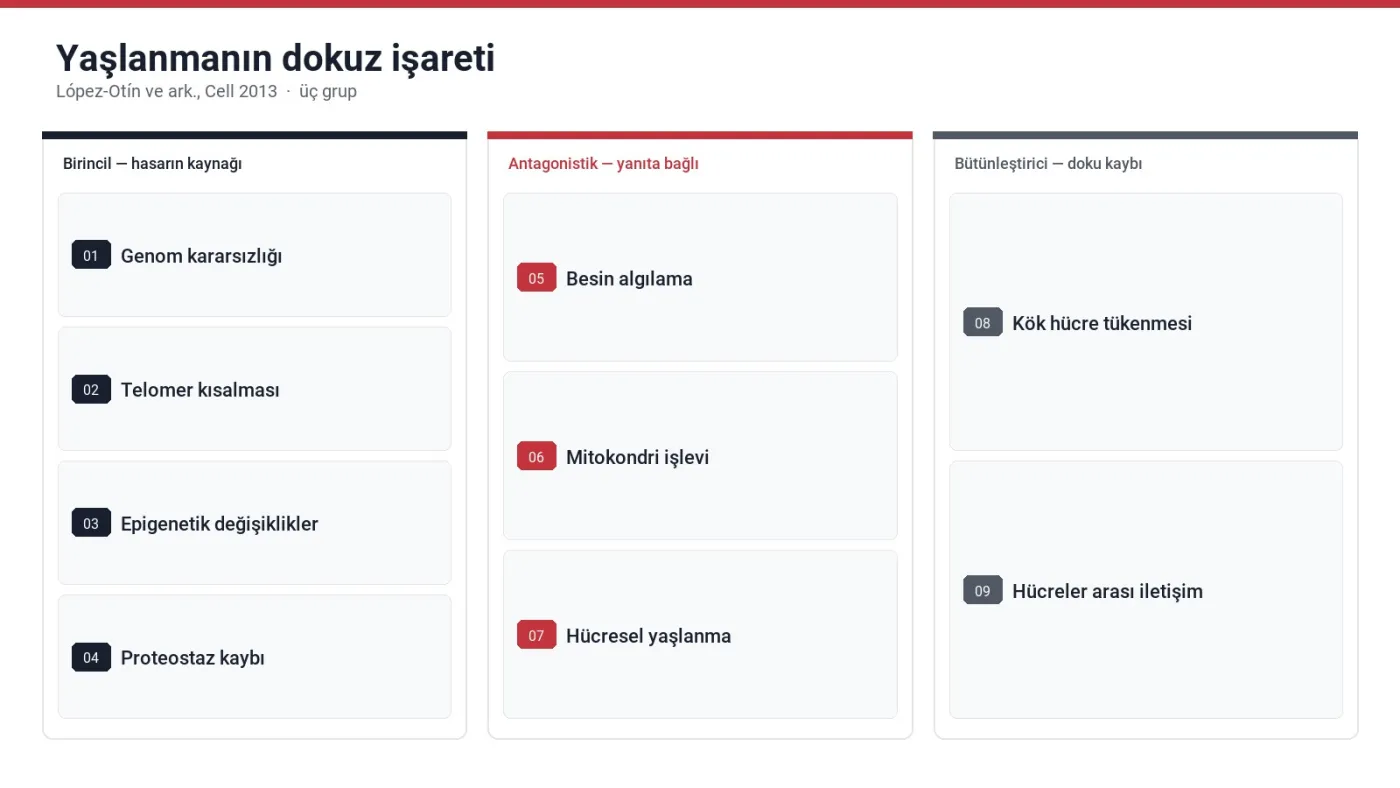
What does genomic instability mean?
The genome is the cell’s template of hereditary information. DNA is the molecule of that template. Every day the cell generates numerous breaks in DNA — lesions. Sunlight, tobacco smoke, and certain chemicals arrive from outside. From within, metabolism, oxygen-derived species, and copying errors during cell division also produce damage. The real question is not whether damage exists; it is how much of that damage is repaired.
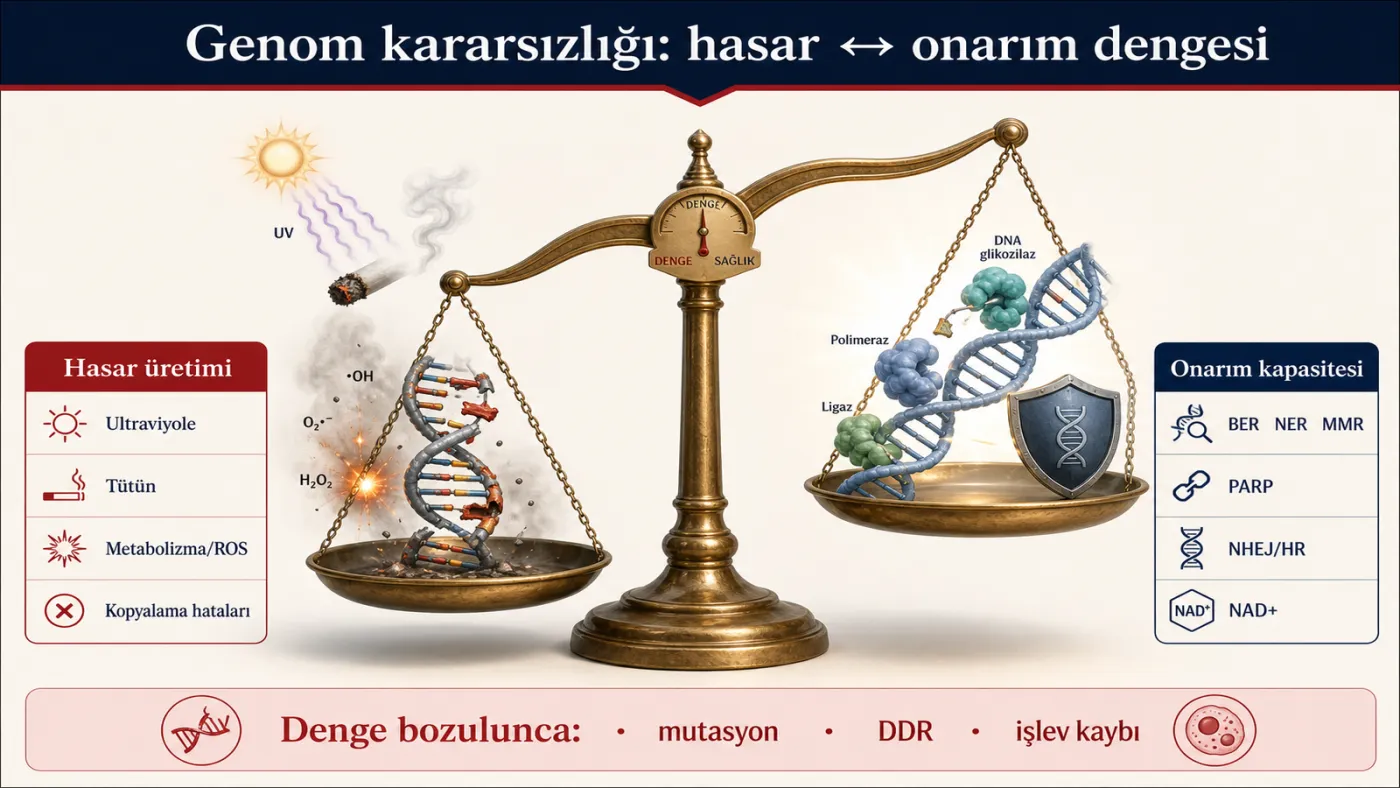
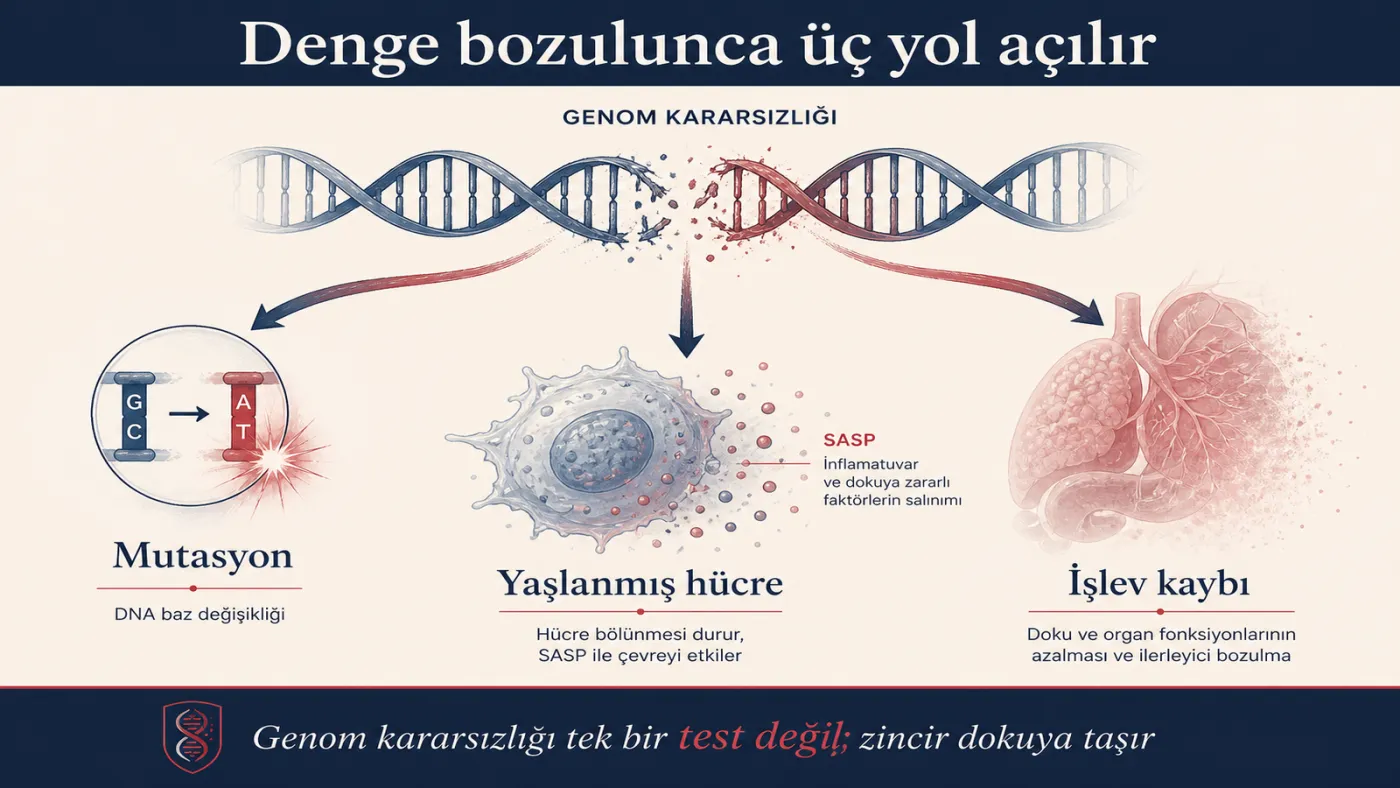
Genomic instability is disruption of the balance between DNA damage and repair capacity. When the balance breaks, three paths open. First, lasting change in the sequence: mutation. Second, the DNA damage response (DDR), which halts cell division or drives the cell towards death. Third, accumulating loss of function where repair cannot keep up. “There is DNA damage in the cell” and “there is genomic instability” are not the same sentence. Damage is part of everyday biology; instability is the state in which maintenance cannot keep pace. The place of DNA damage in ageing is discussed in detail in current reviews (Schumacher et al., 2025).
How does the cell repair DNA?
The cell does not use a single repair pathway. Separate machines work according to the type of damage. Base damage is corrected by base excision repair (BER). Bulky lesions such as those from ultraviolet (UV) light are cleared by nucleotide excision repair (NER). Copying errors are caught by mismatch repair (MMR). At single-strand breaks, the poly(ADP-ribose) polymerase (PARP) family generates signal. Double-strand breaks are among the most severe classes; either the faster but more error-prone non-homologous end joining (NHEJ) or the more accurate homologous recombination (HR) comes into play.
These pathways depend on energy and regulatory molecules. One of them is nicotinamide adenine dinucleotide (NAD⁺). PARP enzymes consume NAD⁺ in the repair signal. The same molecule is also required for sirtuin enzymes that regulate gene expression and repair. As the DNA damage load rises with age, PARP works harder; the NAD⁺ pool is strained. This is the “fuel” side of repair (Covarrubias et al., NAD⁺ metabolism). In longevity management, first cutting damage production and lowering metabolic and inflammatory load protects that fuel indirectly.
Why does the balance break with age?
Repair machines do not run at the same pace with age. At the same time, intracellular oxidative load and low-grade inflammation increase. A chronic DNA damage response pushes the cell towards cellular senescence; the cell may become a senescent cell. A senescent cell stops dividing; the substances it secretes sustain inflammation in neighbouring tissue. That secretion is known as the senescence-associated secretory phenotype (SASP). Leakage of damaged DNA into the cytoplasm also activates immune sensors and drives sterile inflammation. Thus genomic instability does not remain alone; it extends to cellular senescence, inflammation, stem-cell reserve, and intercellular communication. López-Otín and colleagues re-summarised this network in 2023 within the expanded hallmarks framework.
Human biology also shows this through disease. Inherited defects in DNA repair — conditions such as xeroderma pigmentosum, Werner syndrome, and Bloom syndrome — produce phenotypes of premature ageing or elevated cancer risk. These diseases are not a “one-to-one copy of normal ageing”; they show that when repair breaks, an ageing-like picture appears (Panier et al., 2024).
The clinical face: risk, screening, clonal change
The most familiar face of genomic instability in everyday medicine is cancer risk. Smoking, excess ultraviolet exposure, and certain occupational chemicals place a mutagenic load on DNA. Age-appropriate cancer screening aims to catch the clinical consequence of mutation early. In a longevity programme this is not “an extra anti-ageing panel”; it is adherence to evidence-based prevention and screening schedules. The World Health Organization defines healthy ageing not as the absence of disease but as the preservation of functional ability; the same principle is explained in our article on healthy lifespan (healthspan).
Driver mutations that accumulate with age in haematopoietic stem cells, once past a defined threshold, are termed clonal haematopoiesis of indeterminate potential (CHIP). CHIP is not yet a blood cancer; its frequency rises with age and it is followed as a risk marker for haematologic malignancy and cardiovascular events (Jaiswal et al., 2014; 2017). Unexplained blood-count abnormalities or a high-risk clinical picture require haematology evaluation. A single molecular measure labelled “DNA damage count” is not attached to a routine longevity score.
What is done in management?
In the VascularVita approach, genomic instability is addressed in three concrete steps.
First is prevention. Stopping tobacco, reducing ultraviolet exposure, and limiting occupational DNA-damaging exposures directly lower damage production. Age- and sex-appropriate cancer screening catches disease early. Regular exercise, adequate sleep, and control of blood glucose and weight reduce intracellular oxidative load and low-grade inflammation; they support the environment in which repair works.
Second is disease-guided treatment. When diabetes, hypertension, or a similar diagnosis is present, medication and follow-up follow the relevant guidelines. Unexplained blood-count abnormalities, suspicion of CHIP, or suspicion of cancer require haematology or oncology evaluation. Longevity screening assesses the ICOPE domains, frailty, and daily function together; it does not assign a stage from a single molecular “genome score.”
The third step is monitoring over time. As DNA damage accumulates, the cell may shift into a senescent state; the secretion of senescent cells sustains inflammation. That is why attention is not limited to a single laboratory result. The same person’s mobility, energy, cognition, and daily independence are reassessed at defined intervals. The flow is on the individual assessment and ageing stages pages.
Summary
Genomic instability is disruption of the balance between the damage DNA sees every day and the cell’s repair capacity. It is among the primary hallmarks of ageing; it is linked to accumulation of senescent cells, inflammation, and tissue reserve. In VascularVita longevity management, this hallmark is addressed through prevention, indicated treatment, and function-focused monitoring.
References
- López-Otín C, Blasco MA, Partridge L, Serrano M, Kroemer G. The hallmarks of aging. Cell. 2013;153(6):1194–1217. doi:10.1016/j.cell.2013.05.039 · PMC3836174
- López-Otín C, Blasco MA, Partridge L, Serrano M, Kroemer G. Hallmarks of aging: an expanding universe. Cell. 2023;186(2):243–278. doi:10.1016/j.cell.2022.11.001
- Bujarrabal-Dueso A, Garinis GA, Robbins PD, Vijg J, Schumacher B. Targeting DNA damage in ageing: towards supercharging DNA repair. Nat Rev Drug Discov. 2025;24(10):785–807. doi:10.1038/s41573-025-01212-6 · PMC12825315
- Panier S, Wang S, Schumacher B. Genome instability and DNA repair in somatic and reproductive aging. Annu Rev Pathol. 2024;19:261–290. doi:10.1146/annurev-pathmechdis-051122-093128
- Covarrubias AJ, Perrone R, Grozio A, Verdin E. NAD⁺ metabolism and its roles in cellular processes during ageing. Nat Rev Mol Cell Biol. 2021;22(2):119–141. doi:10.1038/s41580-020-00313-x · PMC7963300
- Jaiswal S, Fontanillas P, Flannick J, et al. Age-related clonal hematopoiesis associated with adverse outcomes. N Engl J Med. 2014;371(26):2488–2498. doi:10.1056/NEJMoa1408617 · PMC4306669
- Jaiswal S, Natarajan P, Silver AJ, et al. Clonal hematopoiesis and risk of atherosclerotic cardiovascular disease. N Engl J Med. 2017;377(2):111–121. doi:10.1056/NEJMoa1701719 · PMC6717509
- Coppé JP, Desprez PY, Krtolica A, Campisi J. The senescence-associated secretory phenotype: the dark side of tumor suppression. Annu Rev Pathol. 2010;5:99–118. doi:10.1146/annurev-pathol-121808-102144 · PMC2885946
- Kennedy BK, Berger SL, Brunet A, et al. Geroscience: linking aging to chronic disease. Cell. 2014;159(4):709–713. doi:10.1016/j.cell.2014.10.039 · PMC4852871
- World Health Organization. World report on ageing and health. Geneva: WHO; 2015. who.int
- Cesari M, Araujo de Carvalho I, Amuthavalli Thiyagarajan J, et al. Evidence for the domains of the WHO’s Integrated Care for Older People (ICOPE). J Gerontol A Biol Sci Med Sci. 2018;73(12):1653–1660. doi:10.1093/gerona/gly011
- Fries JF. Aging, natural death, and the compression of morbidity. N Engl J Med. 1980;303(3):130–135. doi:10.1056/NEJM198007173030304
Related articles
- Telomere attrition: chromosome ends and ageing
- Epigenetic alterations: gene expression and ageing
- Loss of proteostasis: protein maintenance and ageing
- Mitochondrial dysfunction: energy and ageing
- Senescent cells
- The nine hallmarks of ageing
- Healthy lifespan (healthspan)
- ICOPE and intrinsic capacity
- Frailty and early findings
- Longevity and healthy living · Ageing stages · Individual assessment