In VascularVita longevity work, the aim is not to reverse chronological age. The aim is to protect the years in which a person can walk, decide, and sustain daily life — healthspan. Ageing is not reduced to a single test. Cellular and molecular decline, organ-system change, a person’s intrinsic capacity and daily function form a single continuum. Management follows from this assessment: define the clinical picture, reduce risk, give indicated treatment and monitor.
At the cellular level, one of the primary drivers in this continuum is loss of proteostasis. In López-Otín and colleagues’ framework of the hallmarks of aging, loss of proteostasis is one of the primary hallmarks. Genome, telomere, and epigenetic layers describe information and regulation; this article explains the cell’s protein machinery. All nine hallmarks appear in the nine hallmarks of ageing; the programme is described in the ageing stages and in individual assessment.
What does proteostasis mean?
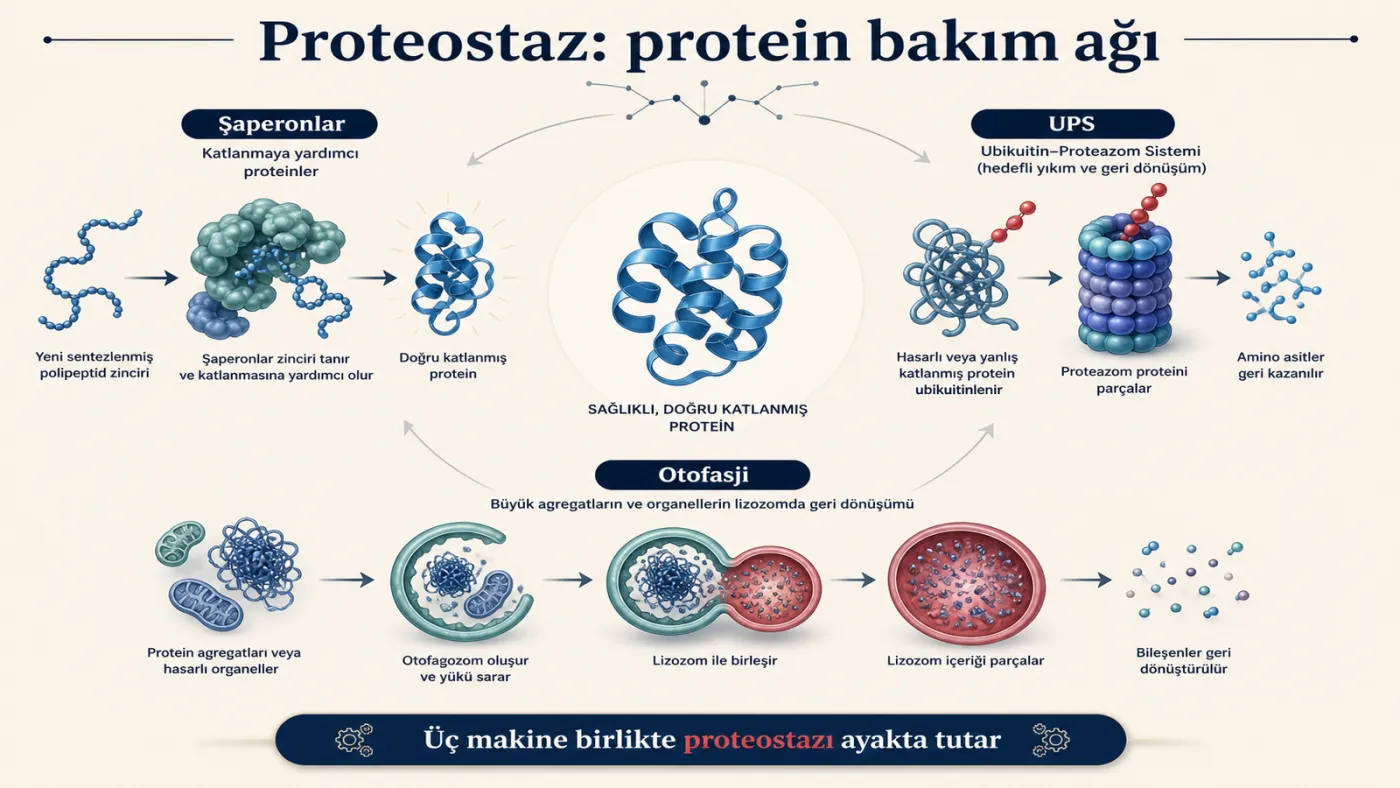
Proteostasis is protein homeostasis: the balance of synthesis, folding, placement, and degradation. Three main machines work. Molecular chaperones put the protein into the correct shape. The ubiquitin–proteasome system (UPS) selectively clears damaged or excess proteins. The autophagy–lysosome pathway sends larger aggregates and some organelles to the lysosome. In the 2023 update, disabled macroautophagy is a separate hallmark candidate; in practice it is considered together with proteostasis and mitochondrial maintenance (López-Otín 2023).

When the balance breaks, misfolded proteins accumulate. That accumulation can promote cellular stress, inflammation, and buildup of senescent cells. Neurons are especially sensitive to aggregates because they do not divide; Alzheimer disease, Parkinson disease, and Huntington disease are classic proteinopathy examples. Skeletal muscle continually demands protein turnover; transthyretin amyloidosis can appear in the ageing heart. These are not indications for a longevity “cleanup product”; they belong to disease-specific care (Hipp et al., 2019).
What can be done?
The most mature lever is lifestyle. Resistance exercise supports muscle protein synthesis and turnover. In older adults, adequate protein intake and regular sleep support the same network. In the appropriate individual, sound nutrition is linked to proteostasis indirectly through mTOR and autophagy; that link overlaps with healthy lifespan and metabolic assessment.
In research, rapamycin and related mTORC1 inhibitors extend lifespan in model organisms by increasing autophagy. There is no completed longevity RCT in humans with an “ageing indication”; trade-offs such as immunosuppression and wound healing exist (Mannick and Lamming, 2023). Spermidine and proteasome activators are at an early research level. Disease-indicated therapies for neurodegeneration and amyloid are a geroscience bridge; they are not a general anti-ageing menu.
What is done in management?
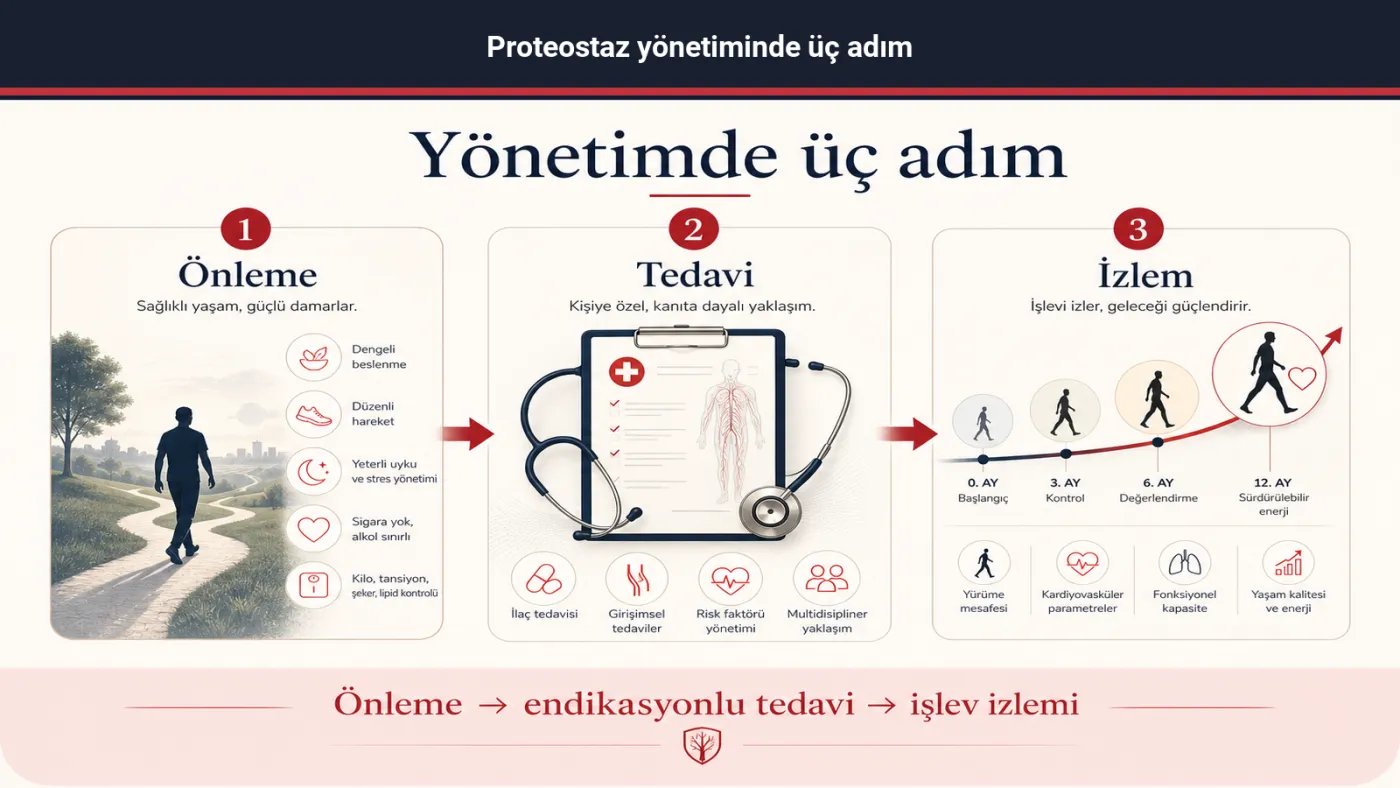
In the VascularVita approach, loss of proteostasis is addressed in three concrete steps.
First is prevention. Resistance exercise, adequate protein, and sleep hygiene support protein maintenance. The aim is not to “erase aggregates with a drug,” but to keep muscle and cellular turnover standing.
Second is disease-guided treatment. Cognitive decline, movement disorders, unexplained cardiac involvement, or sarcopenia are referred to neurology, cardiology or geriatrics as the clinical picture requires. Indicated disease treatment follows the guideline. Longevity screening assesses the ICOPE domains, frailty, and daily function together; it does not assign a stage from a single “proteostasis score.”
The third step is monitoring over time. Loss of proteostasis is linked to inflammation and the senescent-cell state. That is why attention is not limited to a single laboratory result. Grip strength, walking, balance, and independence are reassessed at defined intervals. The flow is on the individual assessment and ageing stages pages.
Summary
Loss of proteostasis is a primary hallmark of ageing that arises when proteins cannot be correctly produced, folded, and cleared. Chaperones, the proteasome, and autophagy are parts of this network. The most mature intervention is resistance exercise and the nutrition–sleep foundation. Rapamycin matters in research; it is not an off-label longevity package. In VascularVita longevity management, this hallmark is addressed through prevention, indicated treatment, and function-focused monitoring.
References
- López-Otín C, Blasco MA, Partridge L, Serrano M, Kroemer G. The hallmarks of aging. Cell. 2013;153(6):1194–1217. doi:10.1016/j.cell.2013.05.039 · PMC3836174
- López-Otín C, Blasco MA, Partridge L, Serrano M, Kroemer G. Hallmarks of aging: an expanding universe. Cell. 2023;186(2):243–278. doi:10.1016/j.cell.2022.11.001
- Hipp MS, Kasturi P, Hartl FU. The proteostasis network and its decline in ageing. Nat Rev Mol Cell Biol. 2019;20(7):421–435. doi:10.1038/s41580-019-0101-y
- Hamazaki J, Murata S. Relationships between protein degradation, cellular senescence, and organismal aging. J Biochem. 2024;175(5):473–480. doi:10.1093/jb/mvae016 · PMC11058314
- Mannick JB, Lamming DW. Targeting the biology of aging with mTOR inhibitors. Nat Aging. 2023;3(6):642–660. doi:10.1038/s43587-023-00416-y
- Kennedy BK, Berger SL, Brunet A, et al. Geroscience: linking aging to chronic disease. Cell. 2014;159(4):709–713. doi:10.1016/j.cell.2014.10.039 · PMC4852871
- World Health Organization. World report on ageing and health. Geneva: WHO; 2015. who.int
- Cesari M, Araujo de Carvalho I, Amuthavalli Thiyagarajan J, et al. Evidence for the domains of the WHO’s Integrated Care for Older People (ICOPE). J Gerontol A Biol Sci Med Sci. 2018;73(12):1653–1660. doi:10.1093/gerona/gly011
- Fried LP, Tangen CM, Walston J, et al. Frailty in older adults: evidence for a phenotype. J Gerontol A Biol Sci Med Sci. 2001;56(3):M146–M156. doi:10.1093/gerona/56.3.m146
Related articles
- Epigenetic alterations: gene expression and ageing
- Deregulated nutrient sensing: metabolism and ageing
- Genomic instability: DNA maintenance and ageing
- Telomere attrition: chromosome ends and ageing
- Mitochondrial dysfunction: energy and ageing
- Senescent cells
- The nine hallmarks of ageing
- Healthy lifespan (healthspan)
- ICOPE and intrinsic capacity
- Frailty and early findings
- Longevity and healthy living · Ageing stages · Individual assessment