
In VascularVita longevity work, the aim is not to reverse chronological age. The aim is to protect the years in which a person can walk, decide, and sustain daily life — healthspan. Ageing is not reduced to a single test. Cellular and molecular decline, organ-system change, a person’s intrinsic capacity and daily function form a single continuum. Management follows from this assessment: define the clinical picture, reduce risk, give indicated treatment and monitor.
At the cellular level, one of the antagonistic drivers in this continuum is mitochondrial dysfunction. In López-Otín and colleagues’ framework of the hallmarks of aging, mitochondria are part of the response to damage: low-level stress signalling can be useful; chronic impairment is harmful. Nutrient sensing describes the cell’s energy decisions; proteostasis describes protein maintenance; this article explains the cell’s energy unit. All nine hallmarks appear in the nine hallmarks of ageing; the programme is described in the ageing stages and in individual assessment.
What do mitochondria do?
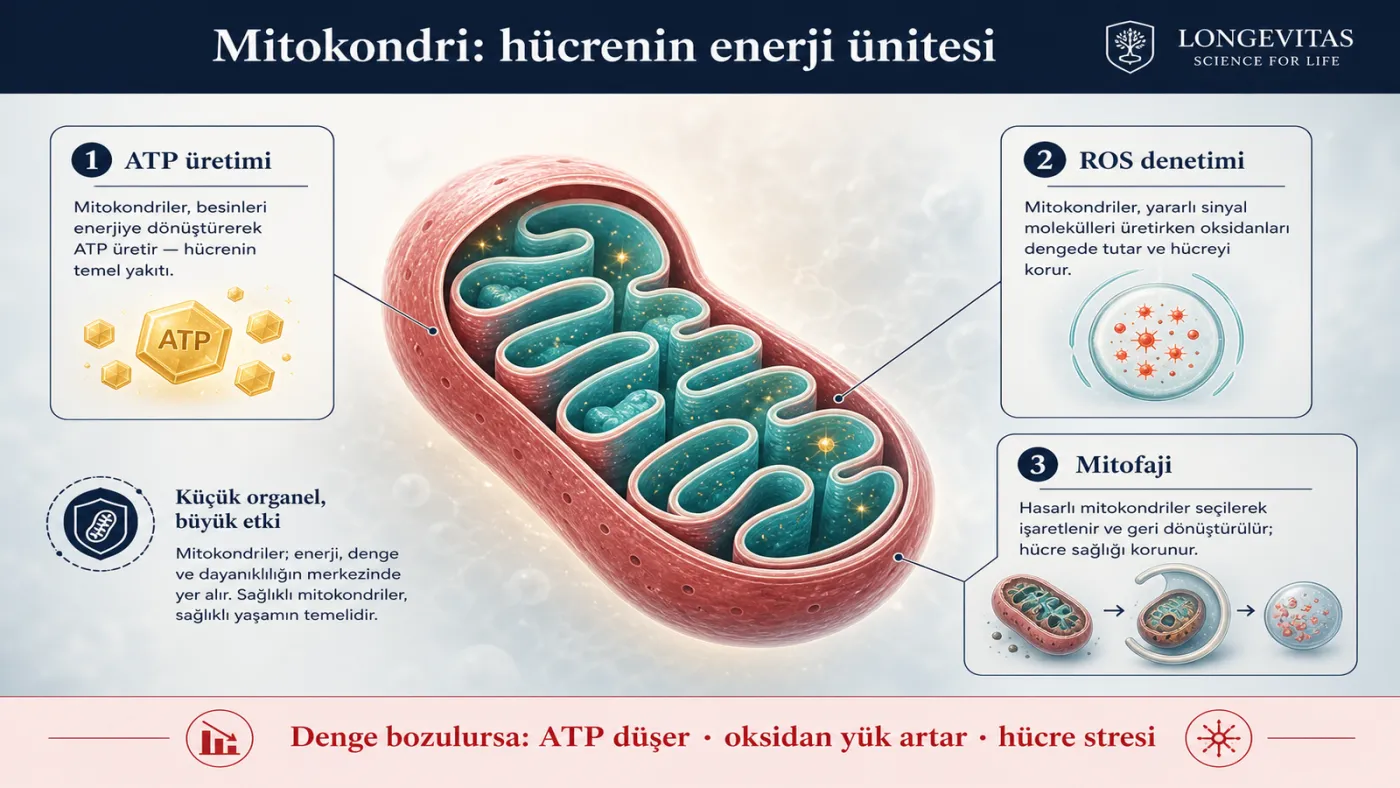
Mitochondria are the cell’s oxidative phosphorylation centre. Electrons from nutrients pass through the respiratory chain; a proton gradient is generated; ATP synthase produces usable energy. The same process generates reactive oxygen species (ROS). At low levels, ROS can act as signals — for example, supporting adaptation after exercise. High and chronic oxidant load increases damage to proteins, lipids, and DNA.
Mitochondria are not merely a “battery.” Calcium buffering, certain metabolite pathways, and a contribution to programmed cell death (apoptosis) also converge on this organelle. Damaged or dysfunctional mitochondrial fragments are delivered to the lysosome by mitophagy, so faulty energy units do not accumulate. Mitophagy is a branch of the autophagy–lysosome network; mitochondrial maintenance is therefore considered together with proteostasis (López-Otín 2023).

Why does the balance break with age?
With age, respiratory capacity declines. Mitochondrial DNA (mtDNA) mutations can accumulate; electron transport efficiency falls. When mitophagy weakens, damaged organelles remain in place. Age-related decline in cofactors such as NAD⁺ also strains energy metabolism. The result is not a single laboratory measure: the cell produces less ATP, oxidant stress rises, and inflammatory signals may increase.
This picture can promote the accumulation of senescent cells. Mitochondrial stress can strengthen the DNA damage response and the SASP; secretions from senescent cells can also disturb the mitochondrial milieu — a bidirectional loop (Miwa et al.). The same network intersects senescent cells, stem cell exhaustion, and intercellular communication.
Clinical face: fatigue, muscle, heart
Tissues with high mitochondrial density — skeletal muscle, heart, brain — reflect energy loss early. Clinical faces overlap with fatigue, exercise intolerance, sarcopenia, some cardiomyopathies, and neurodegenerative pictures. These do not mean a “mitochondrial disease diagnosis”; they are organ faces of a narrowed energy reserve. The World Health Organization defines healthy ageing not as the absence of disease but as the preservation of functional ability; the same principle is developed in our article on healthspan.
In longevity management, a single “mitochondrial score” does not assign a stage. Walking distance, grip strength, endurance, and daily energy are functional proxies. Unexplained serious fatigue or organ involvement is referred to cardiology, neurology or geriatrics as the clinical picture requires.
What can be done?
The most mature lever is endurance exercise and, in suitable individuals, intermittent high-intensity (HIIT-like) loading. Exercise supports mitochondrial biogenesis and mitophagy; sleep and metabolic balance support the same network. In suitable individuals, sound nutrition and weight control connect through nutrient sensing to the AMPK–mTOR balance, which also intersects mitochondrial renewal.
In research, urolithin A (a mitophagy cue), NAD⁺ precursors (NR/NMN), and mitochondria-targeted molecules are studied. There is no established longevity indication in humans; in disease contexts, cardiology or neurology pathways follow guidelines. Advanced approaches such as mitochondrial transplantation are experimental.
What is done in management?
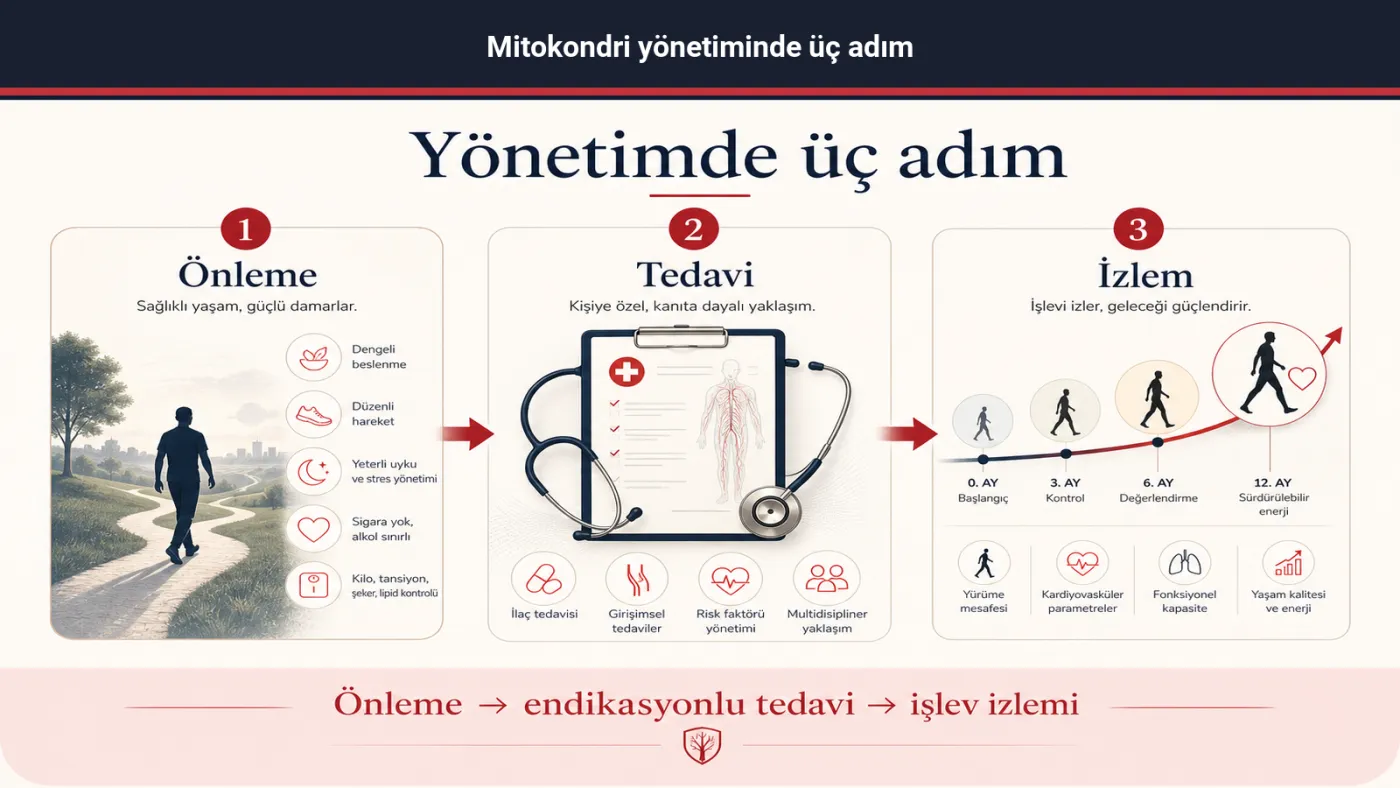
In the VascularVita approach, mitochondrial dysfunction is addressed in three concrete steps.
First is prevention. Endurance and strength exercise, sleep regularity, sound nutrition, and metabolic risk control support energy reserve. The aim is not to “correct” a laboratory score; it is to keep the person’s walking, strength, and endurance capacity upright.
Second is disease-guided treatment. Unexplained fatigue, sarcopenia, cardiac or neurologic involvement is referred to the relevant specialty as the clinical picture requires. Indicated treatment follows the guideline. Longevity screening assesses the ICOPE domains, frailty, and daily function together; it does not assign a stage from a single molecular “mitochondrial score.”
The third step is monitoring over time. Mitochondrial stress can link to senescent-cell accumulation and inflammation. That is why attention is not limited to a single laboratory result. The same person’s walking distance, grip strength, endurance, and daily energy are reassessed at defined intervals. The flow is on the individual assessment and ageing stages pages.
Summary
Mitochondrial dysfunction is an antagonistic hallmark of ageing that arises when the balance of ATP production, ROS control, and mitophagy breaks down. It forms bidirectional links with senescent-cell accumulation and intercellular communication. The most mature intervention is exercise, sleep, and the metabolic base. NAD⁺ and mitophagy candidates are under research. In VascularVita longevity management, this hallmark is addressed through prevention, indicated treatment, and function-focused monitoring.
References
- López-Otín C, Blasco MA, Partridge L, Serrano M, Kroemer G. The hallmarks of aging. Cell. 2013;153(6):1194–1217. doi:10.1016/j.cell.2013.05.039 · PMC3836174
- López-Otín C, Blasco MA, Partridge L, Serrano M, Kroemer G. Hallmarks of aging: an expanding universe. Cell. 2023;186(2):243–278. doi:10.1016/j.cell.2022.11.001
- Miwa S, Kashyap S, Chini E, von Zglinicki T. Mitochondrial dysfunction in cell senescence and aging. J Clin Invest. 2022;132(13):e158447. doi:10.1172/JCI158447
- Li Y, Berliocchi L, Li Z, Rasmussen LJ. Interactions between mitochondrial dysfunction and other aging hallmarks: a review. Life. 2023;13(8):1675. doi:10.3390/life13081675 · PMC10776122
- Covarrubias AJ, Perrone R, Grozio A, Verdin E. NAD⁺ metabolism and its roles in cellular processes during ageing. Nat Rev Mol Cell Biol. 2021;22(2):119–141. doi:10.1038/s41580-020-00313-x · PMC7963300
- Kennedy BK, Berger SL, Brunet A, et al. Geroscience: linking aging to chronic disease. Cell. 2014;159(4):709–713. doi:10.1016/j.cell.2014.10.039 · PMC4852871
- World Health Organization. World report on ageing and health. Geneva: WHO; 2015. who.int
- Cesari M, Araujo de Carvalho I, Amuthavalli Thiyagarajan J, et al. Evidence for the domains of the WHO’s Integrated Care for Older People (ICOPE). J Gerontol A Biol Sci Med Sci. 2018;73(12):1653–1660. doi:10.1093/gerona/gly011
- Fried LP, Tangen CM, Walston J, et al. Frailty in older adults: evidence for a phenotype. J Gerontol A Biol Sci Med Sci. 2001;56(3):M146–M156. doi:10.1093/gerona/56.3.m146
Related articles
- Deregulated nutrient sensing: metabolism and ageing
- Senescent cells (cellular senescence)
- Loss of proteostasis: protein maintenance and ageing
- Altered intercellular communication
- Stem cell exhaustion: the regenerative pool
- The nine hallmarks of ageing
- Healthspan
- ICOPE and intrinsic capacity
- Frailty and early findings
- Healthy longevity · Ageing stages · Individual assessment