In VascularVita longevity work, the aim is not to reverse chronological age. The aim is to protect the years in which a person can walk, decide, and sustain daily life — healthspan. Ageing is not reduced to a single test. Cellular and molecular decline, organ-system change, a person’s intrinsic capacity and daily function form a single continuum. Management follows from this assessment: define the clinical picture, reduce risk, give indicated treatment and monitor.
At the cellular level, one of the integrative drivers in this continuum is altered intercellular communication. In López-Otín and colleagues’ framework of the hallmarks of aging, this hallmark covers the age-related distortion of the messages cells send to one another and to organs. Senescent cells and nutrient sensing contribute to this milieu; this article explains what cells say to each other. All nine hallmarks appear in the nine hallmarks of ageing; the programme is described in the ageing stages and in individual assessment.
How do cells communicate?
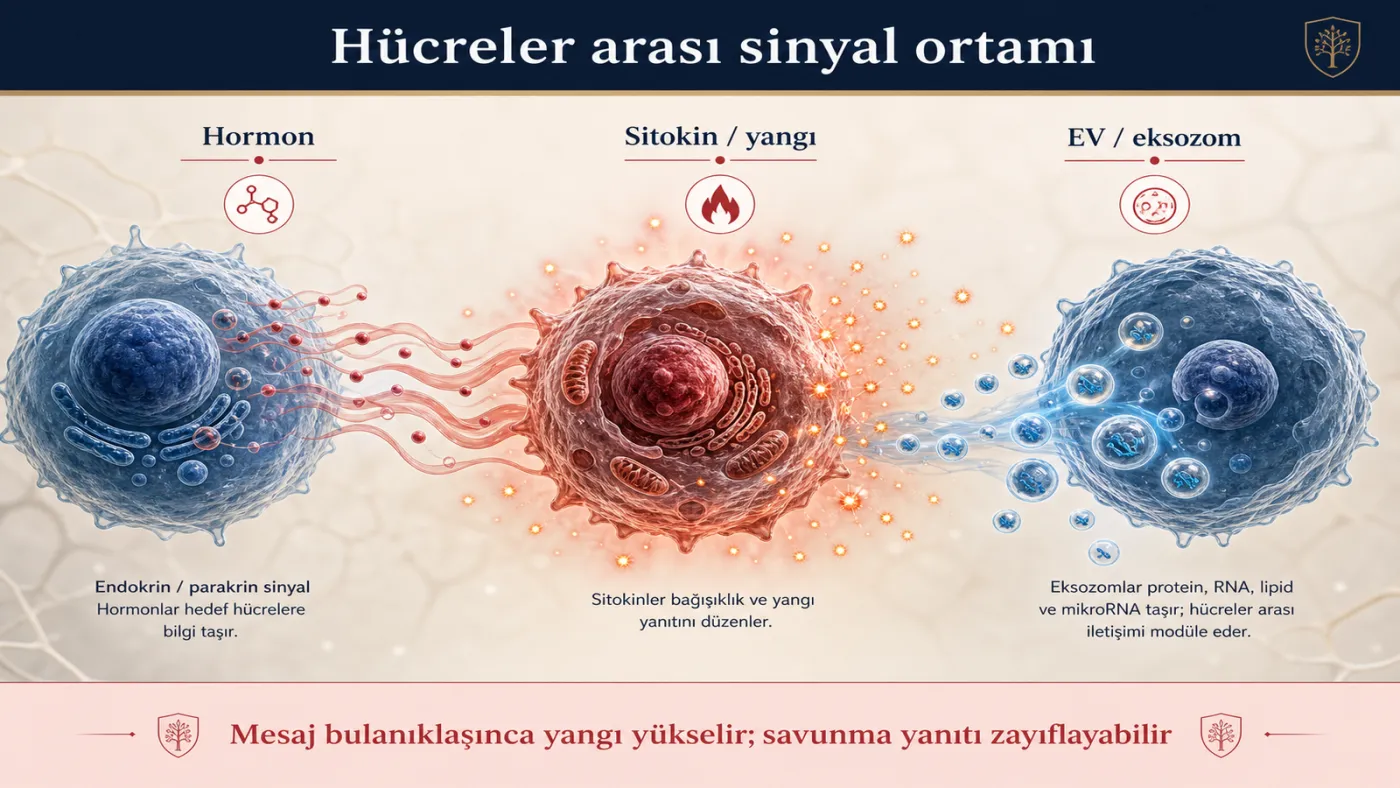
Cells do not work alone. At a distance they communicate with hormones (endocrine), nearby with local secretions (paracrine), through immune cells with cytokines, and with small packages — extracellular vesicles (EVs), also called exosomes. These messages jointly set decisions on growth, repair, inflammation, and rest.
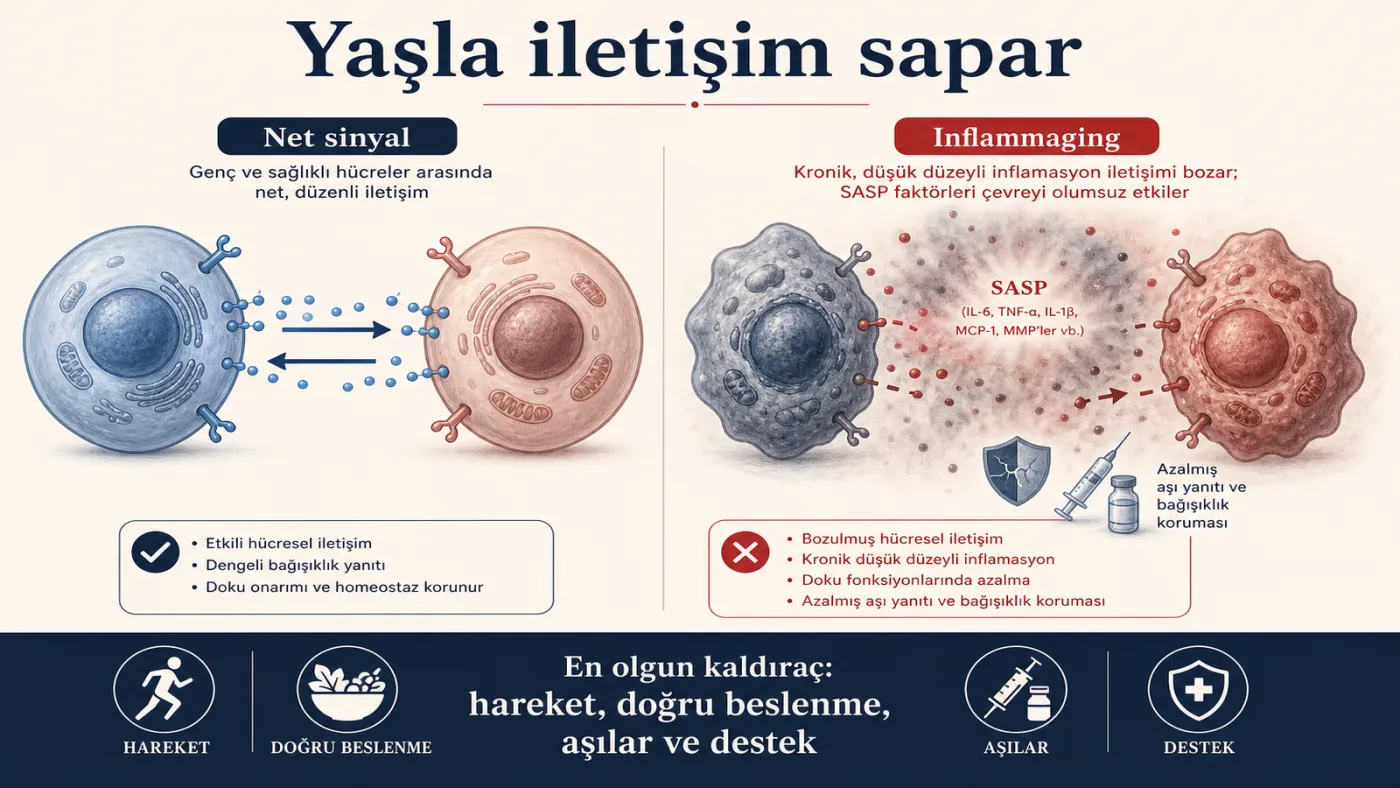
In a young and balanced milieu, the signal is clear: inflammation switches on when needed and resolves when the work is done. With age, messages blur. Low-grade inflammation becomes chronic; immune response may weaken; a disturbed secretion from one organ also affects another. In the 2023 update, chronic inflammation and disruption of the gut microbiome (dysbiosis) are separate hallmark candidates; in practice they are interpreted alongside communication and metabolism (López-Otín 2023).
Why does the balance break with age?
The most familiar face is age-related low-grade inflammation (inflammaging). This is not a high-fever infection; it is a sterile inflammatory load that continues in the background. Secretion from senescent cells (SASP) adds to this burden. Mitochondrial stress and metabolic imbalance also enlarge the same network. The result: vascular endothelium, muscle, brain, and the stem-cell niche share the same “noisy” signalling milieu.
On the immune side, vaccine and infection responses may weaken; this is called immunosenescence (immune ageing). Thus altered communication does not mean only “inflammation is high”; needed defence messages may also weaken. This disruption directly affects the stem-cell niche and the mitochondrial milieu.
Clinical face: inflammation, vessel, defence
Clinical faces overlap chronic inflammatory markers, endothelial stress, reduced vaccine response, and cross-organ ageing effects. They do not amount to a single “communication score” diagnosis; they form a common basis for several diseases. The World Health Organization defines healthy ageing not as the absence of disease but as the preservation of functional ability; the same principle is developed in our article on healthspan.
In longevity management, walking, grip strength, infection–vaccine history, and daily independence are functional proxies. When needed, clinical inflammatory markers are used in physician decisions; alone they do not assign a stage.
What can be done?
The most mature lever is lifestyle, vaccines, and support networks. Regular movement, sound nutrition, sleep, and weight–glucose control help lower the inflammatory base. Age-appropriate vaccines keep immune communication upright. In ICOPE, social and environmental support is part of the same care plan as healthspan.
Omega-3 and similar nutrition interventions may affect inflammatory load in some individuals. Heterochronic plasma and “youthful factors” are early research. Therapeutic exosome / EV approaches remain within tissue-specific research and regulatory frameworks; there is no general longevity indication. For technical details, see the exosome technical file article.

What is done in management?
In the VascularVita approach, altered intercellular communication is addressed in three concrete steps.
First is prevention. Movement, sound nutrition, sleep, metabolic risk control, and age-appropriate vaccines balance the signalling milieu. The aim is not to “zero an inflammation score”; it is to reduce chronic noise and protect function.
Second is disease-guided treatment. In vascular, metabolic, or inflammatory disease, indicated treatment follows the guideline. Longevity screening assesses the ICOPE domains, frailty, and daily function together; it does not assign a stage from a single molecular “communication score.”
The third step is monitoring over time. Communication failure is linked to senescent-cell secretion and the stem-cell niche. That is why attention is not limited to a single laboratory result. The same person’s walking, grip strength, infection load, and independence are reassessed at defined intervals. The flow is on the individual assessment and ageing stages pages.
Summary
Altered intercellular communication is age-related drift in hormone, inflammatory, and vesicle messages; it overlaps inflammaging. Senescent-cell secretion and metabolic imbalance contribute to the same milieu. The most mature intervention is lifestyle, vaccines, and support that protects function. EV / exosome work is under research. In VascularVita longevity management, this hallmark is addressed through prevention, indicated treatment, and function-focused monitoring.
References
- López-Otín C, Blasco MA, Partridge L, Serrano M, Kroemer G. The hallmarks of aging. Cell. 2013;153(6):1194–1217. doi:10.1016/j.cell.2013.05.039 · PMC3836174
- López-Otín C, Blasco MA, Partridge L, Serrano M, Kroemer G. Hallmarks of aging: an expanding universe. Cell. 2023;186(2):243–278. doi:10.1016/j.cell.2022.11.001
- Coppé JP, Desprez PY, Krtolica A, Campisi J. The senescence-associated secretory phenotype: the dark side of tumor suppression. Annu Rev Pathol. 2010;5:99–118. doi:10.1146/annurev-pathol-121808-102144 · PMC2885946
- Franceschi C, Garagnani P, Parini P, Giuliani C, Santoro A. Inflammaging: a new immune–metabolic viewpoint for age-related diseases. Nat Rev Endocrinol. 2018;14(10):576–590. doi:10.1038/s41574-018-0059-4
- Kennedy BK, Berger SL, Brunet A, et al. Geroscience: linking aging to chronic disease. Cell. 2014;159(4):709–713. doi:10.1016/j.cell.2014.10.039 · PMC4852871
- World Health Organization. World report on ageing and health. Geneva: WHO; 2015. who.int
- Cesari M, Araujo de Carvalho I, Amuthavalli Thiyagarajan J, et al. Evidence for the domains of the WHO’s Integrated Care for Older People (ICOPE). J Gerontol A Biol Sci Med Sci. 2018;73(12):1653–1660. doi:10.1093/gerona/gly011
- Fried LP, Tangen CM, Walston J, et al. Frailty in older adults: evidence for a phenotype. J Gerontol A Biol Sci Med Sci. 2001;56(3):M146–M156. doi:10.1093/gerona/56.3.m146
Related articles
- Stem cell exhaustion: the regenerative pool
- Senescent cells (cellular senescence)
- Mitochondrial dysfunction: energy and ageing
- Deregulated nutrient sensing: metabolism and ageing
- Exosome technical file
- The nine hallmarks of ageing
- Healthspan
- ICOPE and intrinsic capacity
- Frailty and early findings
- Healthy longevity · Ageing stages · Individual assessment