
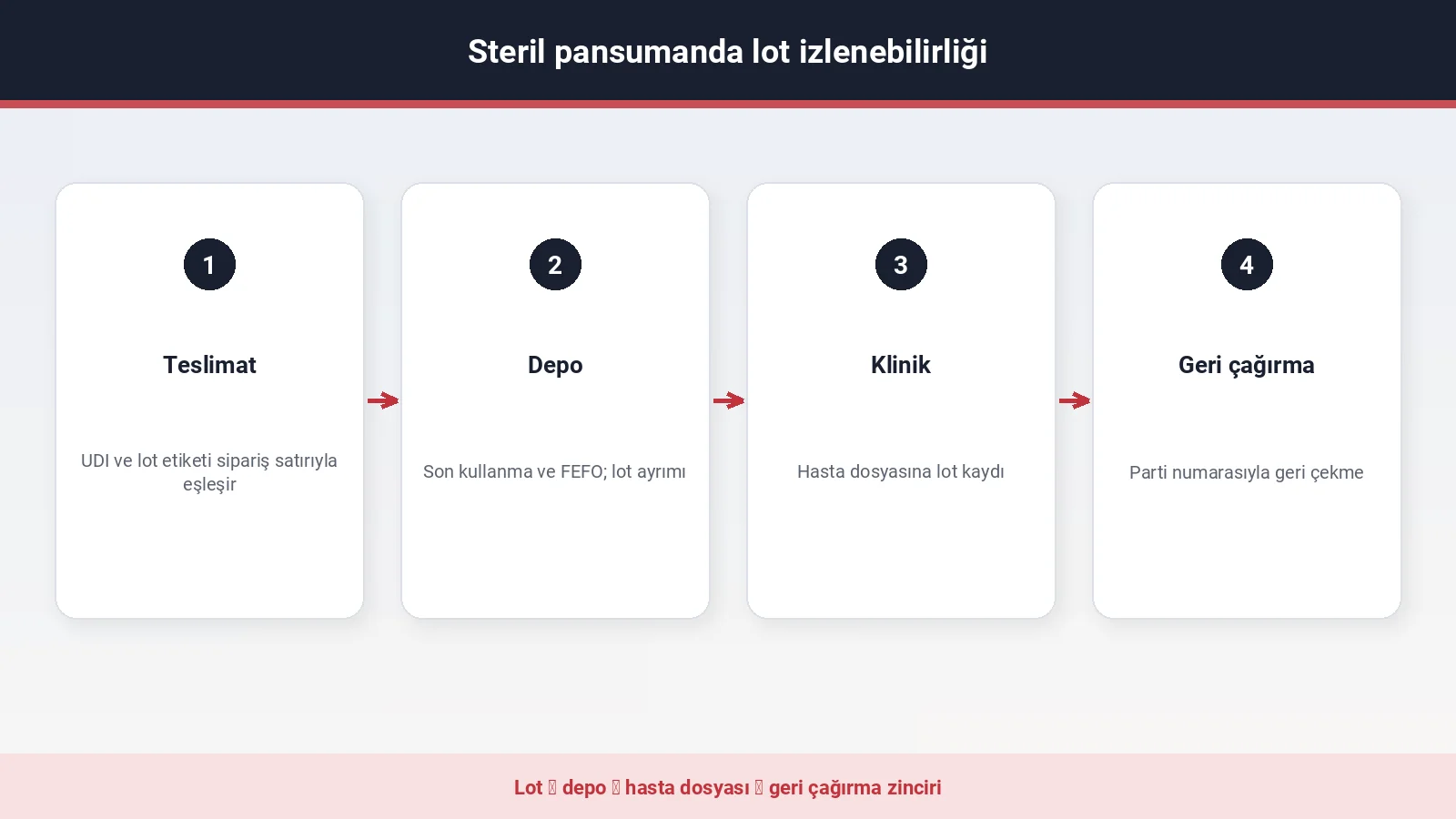
In sterile dressing and wound covering supply, the order form brings in the right product; traceability links that product’s supply and stock movements to the manufacturer’s identity, the product code, the lot number and the expiry date. Recording a lot number against an individual patient is not a universal requirement for every dressing; the risk class of the device, how it is used, national regulation and institutional procedure decide what level of record is needed. In a recall, the aim is to find the affected lot quickly, both in stock and in the units where it was used.
Lot, serial number and UDI: key concepts
A lot (batch) identifies the products the manufacturer associates with a single production run. Sterilisation and quality records are followed through the batch structure the manufacturer defines. A serial number gives a unit-level trace where the manufacturer assigns a separate identity to each device; not every single-use product carries one. Unique Device Identification (UDI) consists of a device identifier (UDI-DI) and, where applicable, a production identifier (UDI-PI). The carrier is usually a barcode; which UDI information appears on the label can vary with the device and the transition timetable.
On the hospital side, in practice this comes down to four fields:
- Product code / barcode — the mapping to the stock keeping unit (SKU) in warehouse automation and the information system; a Global Trade Item Number (GTIN) is not a mandatory synonym for every product code.
- Lot number — batch-level stock, first expired, first out (FEFO) rotation, and recall.
- Serial number — a unit-level trace where the manufacturer has assigned one.
- Expiry date — the validity period of the sterile barrier; checked in the warehouse and again before clinical use.
Checking UDI and lot data is the logistics side of technical file assessment. The revision of the instructions for use (IFU), the CE mark and the label symbols are checked together as described in what to look for in a medical device technical file. When a wound dressing is chosen, the label check starts before the clinical assessment; the order of those questions is described under four headings in the questions we ask before choosing a wound dressing.
Warehouse: goods receipt and stock rotation
At goods receipt three things are matched: the order line, the barcode or UDI, and the physical packaging. The phrase “same product family” does not separate different sizes, pressure classes or sterilisation methods. If a moisture-balance dressing and an antimicrobial dressing are stored on the same shelf, lot separation is essential; category confusion is a frequent cause of stock error.
Two practices stand out in warehouse management:
- FEFO (first expired, first out) — the lot with the nearest expiry date is used first, applied in line with institutional policy.
- Lot separation — different batches of the same SKU are tracked separately in the system; physical placement follows the institution’s warehouse procedure.
Where there is packaging damage, an unreadable label, an indicator of unsuitable storage, or doubt about the integrity of the sterile barrier, the product is quarantined and the decision to accept or return it is made according to institutional procedure and the manufacturer’s information. Not every pack contains a humidity indicator. Lot and expiry information can also matter for recall purposes in non-sterile products.
Return from the clinical unit to the warehouse
When an unused sterile pack is returned from a clinical unit to the warehouse, the lot number, expiry date, packaging integrity and storage conditions are checked again. An opened pack is not considered sterile. Whether an unopened product that has been taken into the procedure area can be returned to stock must be defined explicitly in the infection control and warehouse procedures.
The clinical record: writing the lot number in the patient file
A patient-level lot record is kept for implants, for certain high-risk devices, and for products defined in the institution’s traceability procedure. For routine wound dressings, the level of record required varies with the class of the product, the manufacturer’s information and local rules. The clinical record should at minimum describe the type of product applied and the care plan; where the institution requires a lot record, it should be linked through the barcode or a structured field.
A practical checklist for the clinical team:
- Packaging integrity and expiry date before the procedure.
- Where institutional procedure requires it, entering the lot or UDI information into a structured field at the moment the pack is opened.
- When an antimicrobial dressing is used, recording the clinical rationale and the plan for reassessment, and linking it to the lot record where one is required.
- In an ischaemic wound profile, changing the dressing alone may not be enough until perfusion assessment is complete.
Where signs of infection are assessed clinically, the place of an antimicrobial dressing is considered separately; the indication is based on the stepwise infection continuum described by the International Wound Infection Institute. In a chronic limb-threatening ischaemia (CLTI) profile, revascularisation and wound care run in parallel; each product group’s traceability record is kept according to its own regulation and institutional procedure.
Expiry date: checks in the warehouse and before clinical use
For sterile products the expiry date shows the period the manufacturer has defined for the sterile barrier and for product stability. A lot that has passed its date is removed from the warehouse; a system alert or a manual check is applied before dispatch to the clinical unit.
Managing lots close to expiry affects the purchasing plan. If a high-volume batch arriving as an “urgent order” is placed ahead of existing stock, a FEFO breach can follow. Delivery date and lot priority should be kept on separate lines in the order form. Biological-derived products — exosomes, for example — require a separate record for cold chain and batch consistency; that process is summarised in cold chain and storage in an exosome batch.
Recall: the test of the lot chain
When a manufacturer or a competent authority recalls a batch, the hospital searches for the lot number in warehouse and distribution records and, where necessary, in patient records. For products that do not require a patient-level record, the basis of the recall is identifying the units the product was distributed to and the stock still on hand, quickly.
The role of the business-to-business side during a recall:
- Warehouse — the lot concerned is isolated from stock and dispatch is stopped.
- Purchasing — contact with the supplier, the return or disposal procedure, and ordering an alternative batch.
- Clinical — the list of patients in whom the lot was used is produced and the physician is informed.
- Quality and risk management — incident record, corrective action and notification to the authority, according to institutional protocol.
In interventional stock — balloons, stents, grafts — lot traceability merges with the implant record. A sterile dressing and an interventional device may be held in different form fields of the same patient file; what they share is the recording of the lot or serial number and the UDI. Angioplasty product terminology is summarised in the B2B terminology guide.
Points that are often confused
Treating the lot number as equivalent to the SKU makes different batches invisible under a single product code. Leaving a lot close to expiry outside the FEFO plan carries both waste and compliance risk. For products that require a patient-level lot record, skipping that field makes the scope of a recall harder to define. If the sterile packaging is damaged the product is not used; having a record does not remove a problem with barrier integrity.
In VascularVita supply discussions, sterile dressings, lot labelling and UDI readability are discussed before the order is placed. The delivery format — units per box, barcode standard, language — has to fit the institution’s warehouse system. Stock depth is planned according to the institution’s wound and intervention profile; lot traceability is the safety side of that plan.
Sources
- International Organization for Standardization. ISO 15223-1:2021 — Medical devices — Symbols to be used with information to be supplied by the manufacturer. iso.org
- European Commission. Regulation (EU) 2017/745 on medical devices (MDR), Article 27 — UDI system. eur-lex.europa.eu
- U.S. Food and Drug Administration. UDI Basics. fda.gov
- European Commission. Regulation (EU) 2017/745 on medical devices (MDR), Articles 87–90 and 95 — incident reporting and field safety corrective action. eur-lex.europa.eu
- VascularVita: Technical file · Wound care · Wound dressing assessment