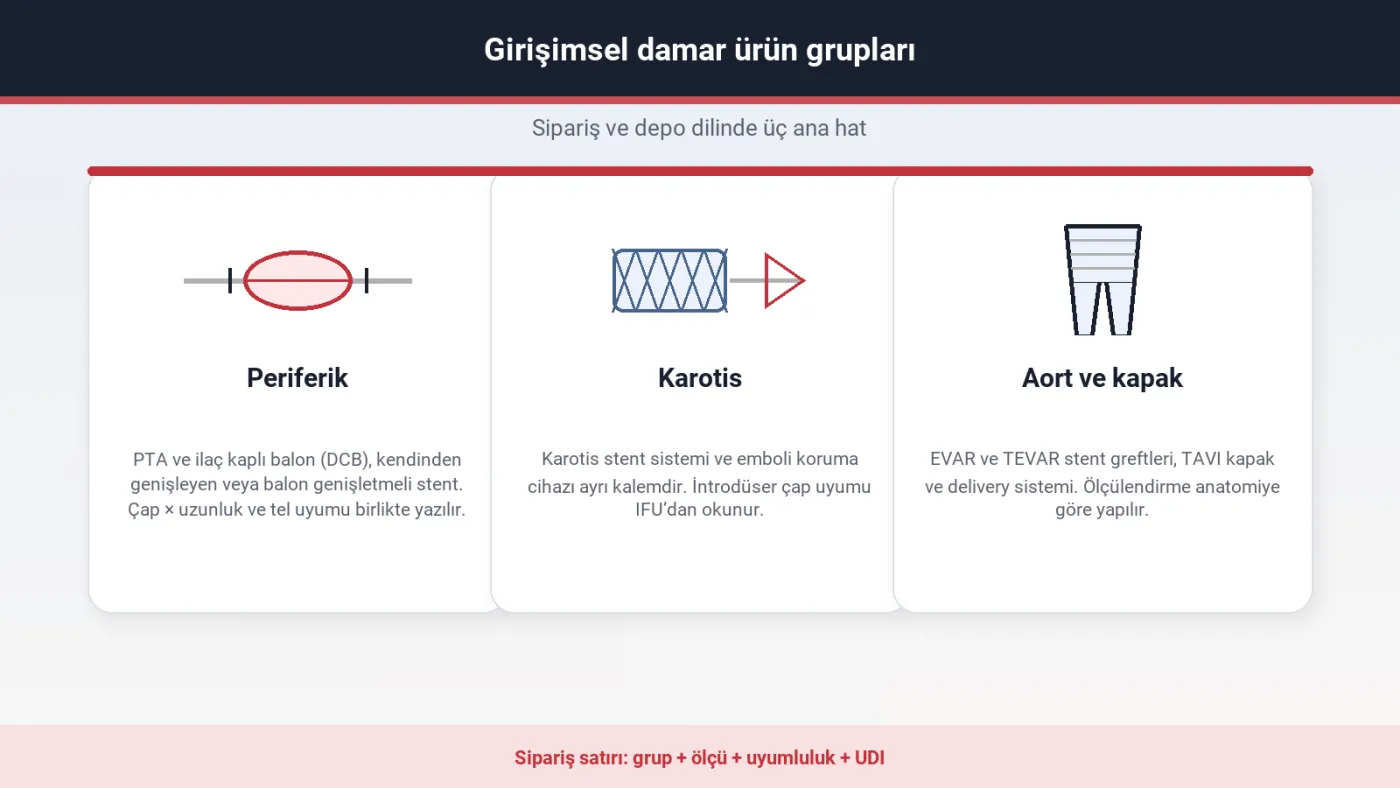
In interventional vascular products, ordering, inventory, and the technical file can use the same sentence with different meanings. “Balloon” may mean a PTA catheter in one place and a drug-coated balloon in another. EVAR and TEVAR belong to the same family, yet anatomy, sizing, and IFU differ. This article summarises product groups in B2B terms so hospital purchasing, warehouse, and clinical teams can use the same terminology.
Peripheral balloon and stent
In peripheral artery disease (PAD), stenosis or occlusion is opened via catheter. A PTA (percutaneous transluminal angioplasty) balloon is inflated inside the vessel to dilate the lesion. Non–drug-coated models are listed as “plain balloon” or “standard PTA.” A DCB (drug-coated balloon) has a drug coating on the balloon surface; in femoral–popliteal or infrapopliteal segments, guidelines place it under a separate heading.
Three dimensions are used often when discussing balloons: diameter (mm), length (mm), and nominal pressure (atm). OTW (over-the-wire) and RX (rapid exchange) describe how the wire advances with the balloon; the stock code and wire compatibility in the IFU (0.014–0.035 inch) should be checked together.
If there is risk of recoil or dissection in the vessel wall after balloon dilation, a peripheral stent comes into play. The self-expanding versus balloon-expandable distinction is decisive for anatomy and diameter selection. The coronary stent portfolio must not be mixed with this group; VascularVita’s focus is peripheral artery, carotid, and aortic / structural heart interventions.
Product categories and the need–assessment table appear on the angioplasty page. When critical limb ischaemia and wound care intersect in the same patient, the clinical approach is summarised in vascular health and healthspan.
Carotid products
In endovascular management of carotid (neck artery) stenosis, a carotid stent and, when needed, an embolic protection device (filter or balloon) are planned together. On the purchasing side, “stent” alone is not enough: stent diameter and length, introducer compatibility, and filter type are separate line items.
Embolic protection provides a temporary barrier against debris that could reach the brain during the procedure. Filter- and balloon-based systems have different IFUs and use steps; the full product name is preferred on the warehouse label over an abbreviation. If carotid and peripheral stents are stored on the same shelf, lot and expiry separation is critical for traceability.
Warehouse and label terminology
- Carotid stent system — usually a stent + delivery system set
- Embolic protection device — filter or proximal protection; SKU independent of the stent
- Introducer / sheath — access sheath; diameter compatibility is stated in the stent IFU
EVAR and TEVAR
In aortic aneurysm repair, endovascularly placed stent graft systems fall into two main groups:
- EVAR (endovascular aneurysm repair) — abdominal aortic aneurysm
- TEVAR (thoracic endovascular aortic repair) — thoracic aortic pathology
In both groups, the term “graft” refers to the combination of metal scaffold and graft fabric. Sizing is done by anatomy: proximal and distal neck length, diameter, angulation, and branching (fenestrated or branched graft) are separate fields on the order form. “Endograft” and “stent graft” point to the same product family; the commercial name changes by manufacturer.
Because of thoracic anatomy and urgency, TEVAR logistics and stock policy are run differently from EVAR. Institutional policy decides between holding a limited number of “standard sizes” for emergency cases and ordering after full sizing. Sterile packaging, radiopaque markers, and the compatible delivery system list in the IFU are added to the purchasing checklist.
TAVI
TAVI (transcatheter aortic valve implantation) is placement of a valve prosthesis via catheter in selected patients with aortic stenosis. The product group is separate from balloons or peripheral stents: valve prosthesis, delivery sheath, dilation balloon (depending on model), and access sets are different components.
On the B2B side, “TAVI set” often means valve + system; however, access (transfemoral, transapical, etc.) and valve size are coded separately. Shared vocabulary between the structural heart team and purchasing: annulus diameter, valve type (balloon-expandable / self-expanding), and introducer diameter. This field updates quickly; the technical file revision should be matched to the lot in stock.
Purchasing and warehouse terminology
Order forms for interventional products generally include these headings:
- Indication / anatomic region — peripheral, carotid, abdominal aorta, thoracic aorta, aortic valve
- Device class — balloon, stent, graft, valve, embolic protection
- Dimensions — diameter × length (mm); for grafts, neck and iliac extension
- Compatibility — wire diameter, sheath diameter, compatible accessory list (IFU)
- Sterility / UDI — lot, serial, expiry, barcode
The same abbreviation can point to different products across brands. Writing “DCB” and shipping a plain balloon, or saying “EVAR” when a thoracic graft is requested, are common causes of warehouse errors. In the technical file (IFU), the anatomic indication and sizing table should be reviewed before the marketing summary.
The clinical approach for the balloon-versus-stent discussion in a peripheral segment is a separate topic; on the supply side both categories can be held in stock. When venous and arterial wounds are seen on the same service, dressing selection starts with the questions in wound dressing assessment; compression need after endovenous laser is planned together with medical laser wavelength and the compression product range.
The current list of product groups and category mapping appears on the angioplasty page. For lot- and characterisation-focused technical file review, the headings in exosome technical file offer a similar checklist.
Sources
- Aboyans V, et al. 2017 ESC Guidelines on the Diagnosis and Treatment of Peripheral Arterial Diseases. Eur Heart J. 2018. doi:10.1093/eurheartj/ehx095
- Aboyans V, et al. 2024 ESC Guidelines for the management of peripheral arterial and aortic diseases. Eur Heart J. 2024. doi:10.1093/eurheartj/ehae179
- European Society for Vascular Surgery (ESVS) Clinical Practice Guidelines on the Management of Abdominal Aorto-iliac Artery Aneurysms. Eur J Vasc Endovasc Surg. 2019. doi:10.1016/j.ejvs.2018.09.020
- Rosenfield K, et al. 2023 ACC/AHA Guideline for the Management of Patients With Chronic Coronary Disease (cross-reference for carotid and peripheral sections). Circulation
- VascularVita product scope: Angioplasty product groups