Endovenous laser closes an incompetent superficial vein with heat delivered from inside the vessel. The device’s wavelength (nanometres, nm) determines where energy is converted to heat in tissue. This article summarises the main wavelengths used on the market, what they treat, and what is considered in selection.
What does it treat?
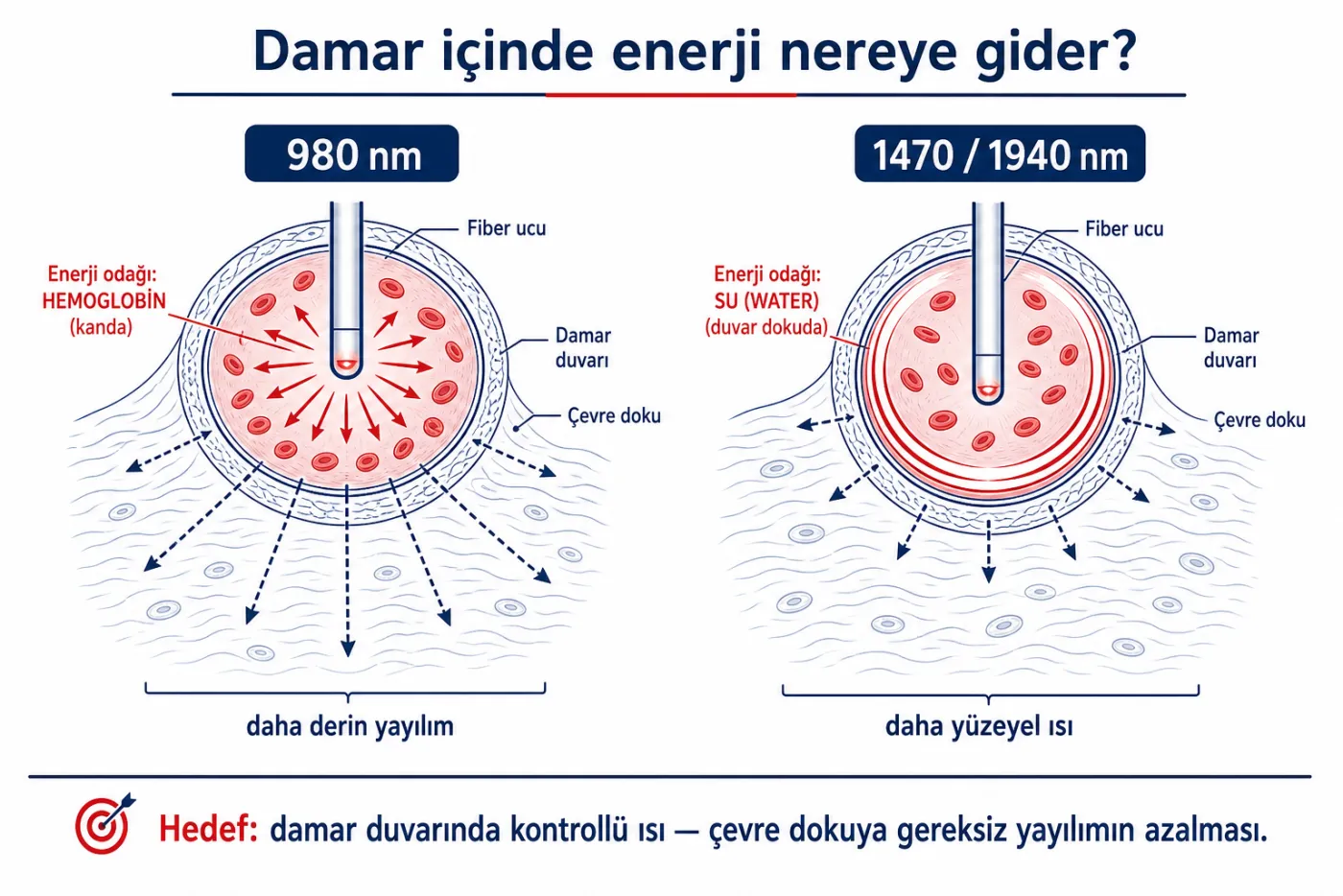
This article focuses on endovenous laser ablation (EVLA): reflux in superficial veins such as the great and small saphenous veins, and related varicose veins / chronic venous disease. The aim is to close the incompetent vein with controlled heat from inside the vessel rather than by surgical stripping.
The same diode laser platforms are also used, with an appropriate fibre, for laser haemorrhoidoplasty, lipolysis, and selected skin applications (commonly 980 and 1470 nm).
What is assessed?
- Wavelength (nm) — target chromophore: haemoglobin or water?
- Power (watts) and energy density (J/cm, LEED) — heat dose delivered along the vein
- Fibre tip — bare, jacketed, or radial; energy distribution changes
- Vein diameter and wall thickness — dose and pullback speed are set accordingly
- Ultrasound guidance and tumescent anaesthesia — part of procedural safety
Why does wavelength matter?
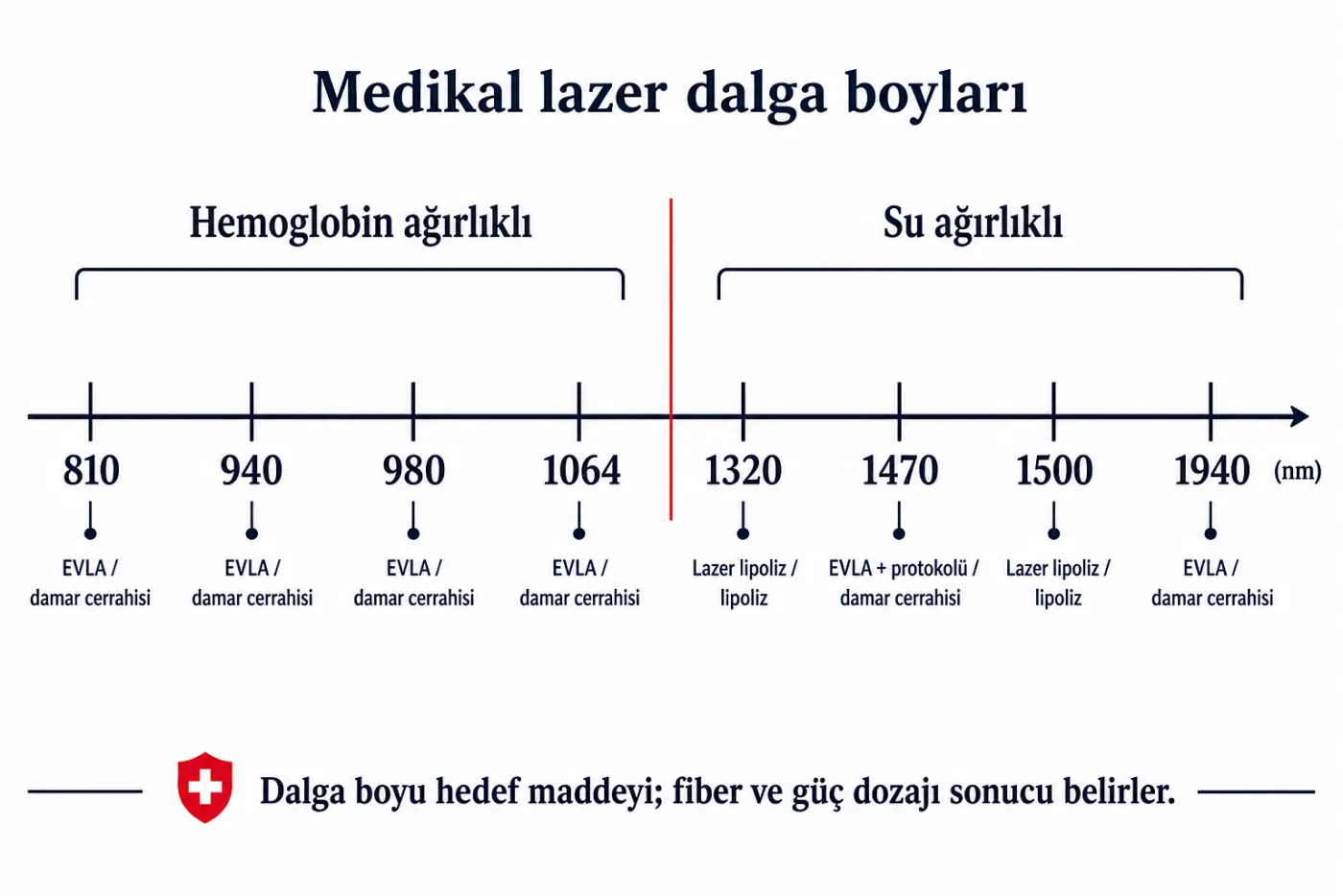
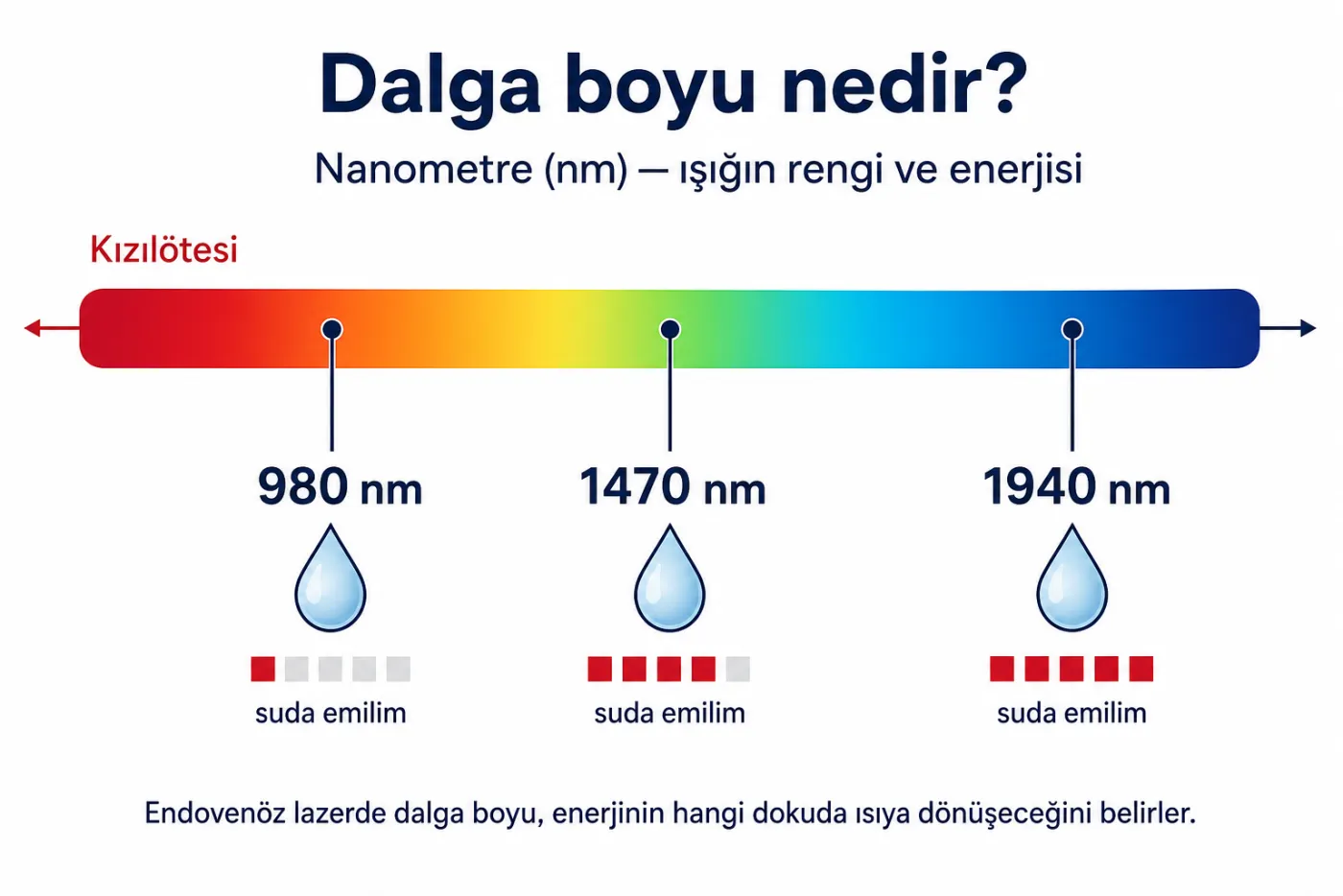
At shorter wavelengths (about 810–1064 nm), haemoglobin absorption predominates; heat forms mainly through blood inside the vein, and tissue penetration is deeper. At longer wavelengths (about 1320 nm and above), water absorption predominates; energy converts to heat closer to the fibre tip, and lower power / energy is generally used for the same closure. Early postoperative pain and bruising profiles are also linked to this choice.
Main wavelengths on the market
The list below covers values used in endovenous (and related) commercial systems. The summary is physical and clinical rather than brand- or model-specific.
Haemoglobin-weighted (short)
- 810 nm — Among early EVLA wavelengths. High haemoglobin absorption; a historical reference point.
- 940 nm — Haemoglobin target; for a long period one of the widely used diode EVLA options in Europe.
- 980 nm — Still a commonly encountered shorter wavelength. Used in varicose-vein EVLA; also appears on proctology platforms (for example haemorrhoid laser). Compared with 1470 nm, higher energy and more early postoperative complaints have generally been reported.
- 1064 nm — Nd:YAG band. A haemoglobin / tissue absorption balance; used in EVLA and some surgical applications.
Water-weighted (long)
- 1320 nm — Transition band towards water absorption. High closure rates have been reported at lower energy densities.
- 1470 nm — Today the standard diode wavelength for EVLA in many centres. Strong water absorption; often preferred with a radial fibre. Also common for proctology (LHP and similar).
- 1500 / 1510 nm — Water-absorbing diodes close to the 1470 family; appear in the literature with similar logic.
- 1920 / 1940 / 1950 nm — Still higher water absorption. Heat very close to the fibre tip; lower power is used in thin-walled veins. In thick-walled veins such as the saphenous, the clinical difference versus 1470 nm is not always clear; long-term closure and the power used should be interpreted together.
Short summary table
- 810–1064 nm — Main target: haemoglobin · Treatment: EVLA (varicose veins / reflux) · Watch: deeper spread, generally higher dose
- 1320–1510 nm — Main target: water · Treatment: EVLA (current standard practice 1470) · Watch: heat near the wall, low–moderate LEED
- 1920–1950 nm — Main target: water (higher) · Treatment: EVLA · Watch: highly local heat, power / wall-thickness balance
For product scope and technical information, see our medical laser page. For patient information, Dr. Kadir Çeviker’s varicose veins article is useful.
Sources
- van den Bos RR, et al. Endovenous laser ablation (EVLA): mechanisms and modeling. Lasers Med Sci. 2014. DOI: 10.1007/s10103-013-1480-5 · PubMed 24220848
- Doğancı S, Demirkılıç U. 980 nm bare-tip vs 1470 nm radial fibre. Eur J Vasc Endovasc Surg. 2010. DOI: 10.1016/j.ejvs.2010.04.006 · PubMed 20547079
- Cowpland CA, Cleese AL, Whiteley MS. Optimal linear endovenous energy density for EVLA — clinical evidence review. Phlebology. 2017. DOI: 10.1177/0268355516648067 · PubMed 27207444
- Keo HH, et al. 1940-nm water-specific wavelength for saphenous ablation. J Vasc Surg Cases Innov Tech. 2023. DOI: 10.1016/j.jvscit.2023.101125 · PubMed 37334164
- Whiteley MS. EVLA 1470 nm vs 1940 nm — comparison. PubMed 35415834
- VascularVita — Medical laser