
In VascularVita longevity work, the aim is not to reverse chronological age. The aim is to protect the years in which a person can walk, decide, and sustain daily life — healthspan. Ageing is not reduced to a single test result. Cellular and molecular decline, organ-system change, a person’s intrinsic capacity and daily function form a single continuum. Management follows from this assessment: define the clinical picture, reduce risk, give indicated treatment and monitor.
At the cellular level, one of the primary drivers in this continuum is epigenetic alterations. In López-Otín and colleagues’ framework of the hallmarks of aging, epigenetic drift is one of the primary hallmarks. Genomic instability describes maintenance of the DNA template; telomere attrition describes the chromosome end; this article explains the layer that governs which gene runs when on that same template. All nine hallmarks appear in the nine hallmarks of ageing; the programme is described in the ageing stages and in individual assessment.
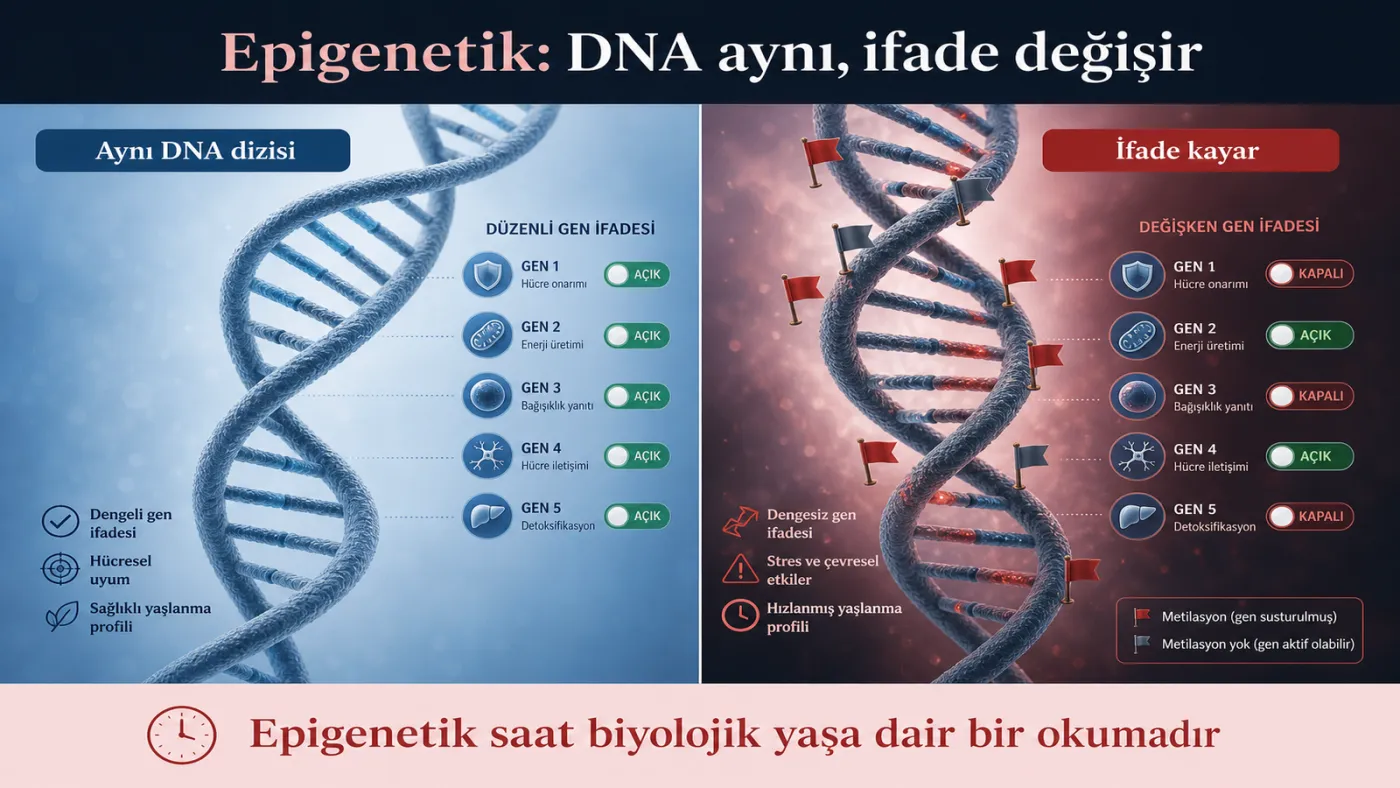
What does epigenetics mean?
The genome is the cell’s hereditary map. The epigenome comprises the chemical and structural marks that determine which genes are expressed, and when, on that map. There are three main layers: DNA methylation (methyl groups at CpG sites), histone modifications (opening and closing of chromatin), and chromatin organisation (how DNA is arranged inside the nucleus).
With age, methylation decreases in some regions and increases in others. Regions that should stay silent can open; gene expression becomes noisy. The result is a weakened capacity to produce the right protein at the right time. This drift is also driven by inflammation, metabolic stress, and the DNA damage response; it does not stand alone (López-Otín 2023).
What is an epigenetic clock?
Researchers derive numerical predictors from methylation patterns in blood or tissue. These are called epigenetic clocks. Some clocks approximate chronological age; others relate more closely to mortality or disease risk (e.g., GrimAge). Some attempt to measure the “pace” of ageing (e.g., DunedinPACE).

Clocks are scientifically valuable; in a clinical longevity programme they alone cannot advance a stage. VascularVita assessment first covers the ICOPE domains, frailty, and daily function. When clock data exist, they are interpreted in the context of function and risk; no product claim such as “your biological age is X” is made. The World Health Organization defines healthy ageing not as the absence of disease but as the preservation of functional ability; the same principle runs through our article on healthy lifespan (healthspan).
What is partial reprogramming?
The Yamanaka factors defined in 2006 — OSKM (Oct4, Sox2, Klf4, c-Myc) — can convert a mature cell into a pluripotent stem cell. The real interest in longevity research is partial cellular reprogramming: factors are applied briefly or cyclically; epigenetic “age” marks are pulled towards a youthful direction while the cell’s tissue identity is intended to be preserved. A frequently used variant is OSK (without c-Myc).
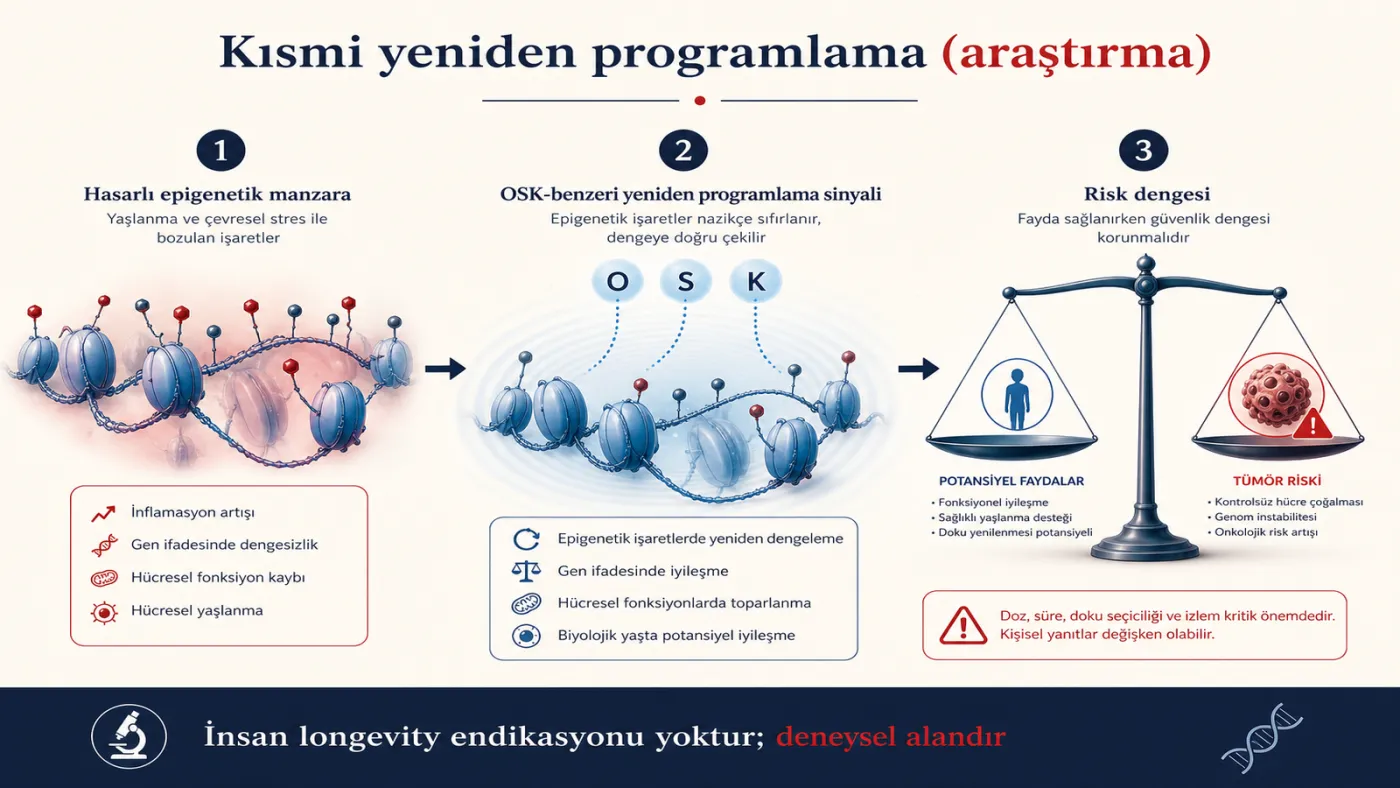
In animal models, cyclic or controlled OSK/OSKM regimens have rolled back the epigenetic clock and improved some tissue and functional parameters (Ocampo 2016; Lu 2020; Browder 2022). Excessive or uncontrolled application carries risks of loss of cell identity and tumorigenesis. There is no general “ageing indication” in humans. Early safety-focused clinical trials are planned or underway in selected disease pathways (e.g., optic neuropathy); that does not mean systemic rejuvenation therapy.
What is done in management?
In the VascularVita approach, epigenetic drift is addressed in three concrete steps.
First is prevention. Regular exercise, adequate sleep, smoking cessation, and control of blood glucose and weight influence the epigenome indirectly. The aim is not to “reset the clock,” but to quiet the environment in which gene expression is disrupted.
Second is disease-guided treatment. When diabetes, hypertension, or another diagnosis is present, medication and follow-up follow the relevant guideline. Epigenetic regulatory drugs remain within oncology or disease indications; no off-label “anti-ageing” protocol is written.
The third step is monitoring over time. Epigenetic drift is linked to accumulation of senescent cells, inflammation, and tissue reserve. That is why attention is not limited to a single methylation score. Mobility, energy, cognition, and independence are reassessed at defined intervals. The flow is on the individual assessment and ageing stages pages.
Summary
Epigenetic alterations are disruption of the timing of gene expression while the DNA sequence stays the same. They are among the primary hallmarks of ageing. Epigenetic clocks are valuable in research and risk contexts; they are not, alone, a clinical stage. Partial reprogramming is a strong experimental lever in animals; it is not presented as a human longevity therapy. In VascularVita longevity management, this hallmark is addressed through prevention, indicated treatment, and function-focused monitoring.
References
- López-Otín C, Blasco MA, Partridge L, Serrano M, Kroemer G. The hallmarks of aging. Cell. 2013;153(6):1194–1217. doi:10.1016/j.cell.2013.05.039 · PMC3836174
- López-Otín C, Blasco MA, Partridge L, Serrano M, Kroemer G. Hallmarks of aging: an expanding universe. Cell. 2023;186(2):243–278. doi:10.1016/j.cell.2022.11.001
- Ocampo A, Reddy P, Martinez-Redondo P, et al. In vivo amelioration of age-associated hallmarks by partial reprogramming. Cell. 2016;167(7):1719–1733.e12. doi:10.1016/j.cell.2016.11.052
- Lu Y, Brommer B, Tian X, et al. Reprogramming to recover youthful epigenetic information and restore vision. Nature. 2020;588(7836):124–129. doi:10.1038/s41586-020-2975-4 · PMC7752134
- Browder KC, Reddy P, Yamamoto M, et al. In vivo partial reprogramming alters age-associated molecular changes during physiological aging in mice. Nat Aging. 2022;2(3):243–253. doi:10.1038/s43587-022-00283-z
- Pereira B, Correia FP, Alves IA, et al. Epigenetic reprogramming as a key to reverse ageing and increase longevity. Ageing Res Rev. 2024;95:102204. doi:10.1016/j.arr.2024.102204
- Lu AT, Quach A, Wilson JG, et al. DNA methylation GrimAge strongly predicts lifespan and healthspan. Aging (Albany NY). 2019;11(2):303–327. doi:10.18632/aging.101684 · PMC6366976
- Belsky DW, Caspi A, Corcoran DL, et al. DunedinPACE, a DNA methylation biomarker of the pace of aging. eLife. 2022;11:e73420. doi:10.7554/eLife.73420
- Takahashi K, Yamanaka S. Induction of pluripotent stem cells from mouse embryonic and adult fibroblast cultures by defined factors. Cell. 2006;126(4):663–676. doi:10.1016/j.cell.2006.07.024
- World Health Organization. World report on ageing and health. Geneva: WHO; 2015. who.int
- Cesari M, Araujo de Carvalho I, Amuthavalli Thiyagarajan J, et al. Evidence for the domains of the WHO’s Integrated Care for Older People (ICOPE). J Gerontol A Biol Sci Med Sci. 2018;73(12):1653–1660. doi:10.1093/gerona/gly011
Related articles
- Telomere attrition: chromosome ends and ageing
- Loss of proteostasis: protein maintenance and ageing
- Genomic instability: DNA maintenance and ageing
- Stem cell exhaustion: the regenerative pool
- The nine hallmarks of ageing
- Healthy lifespan (healthspan)
- ICOPE and intrinsic capacity
- Frailty and early findings
- Longevity and healthy living · Ageing stages · Individual assessment