
In hospital purchasing and warehouse teams, the “technical file” is often sought as a single PDF. In medical device supply, however, the file means reviewing the instructions for use (IFU), the label, regulatory marks, and traceability data together. Even when balloon diameter is correct, delivery acceptance stops if the IFU revision is outdated, the lot number does not match the barcode, or CE information is missing. This article summarises the order and headings for reviewing a technical file on the B2B supply side; it offers a general checklist rather than a product-code or SKU list.
What is the technical file, and where does the IFU fit in?
The technical file is the body of documentation the manufacturer maintains for regulatory conformity; hospitals usually do not see the full file. What purchasing and clinical teams typically hold is the instructions for use (IFU — Instructions for Use) and the product label. The IFU contains the intended use, warnings, sizing tables, compatible accessories, and sterilisation information. For interventional vascular products, wire diameter, sheath compatibility, and nominal pressure appear in an IFU table; abbreviations in a marketing summary do not replace that table.
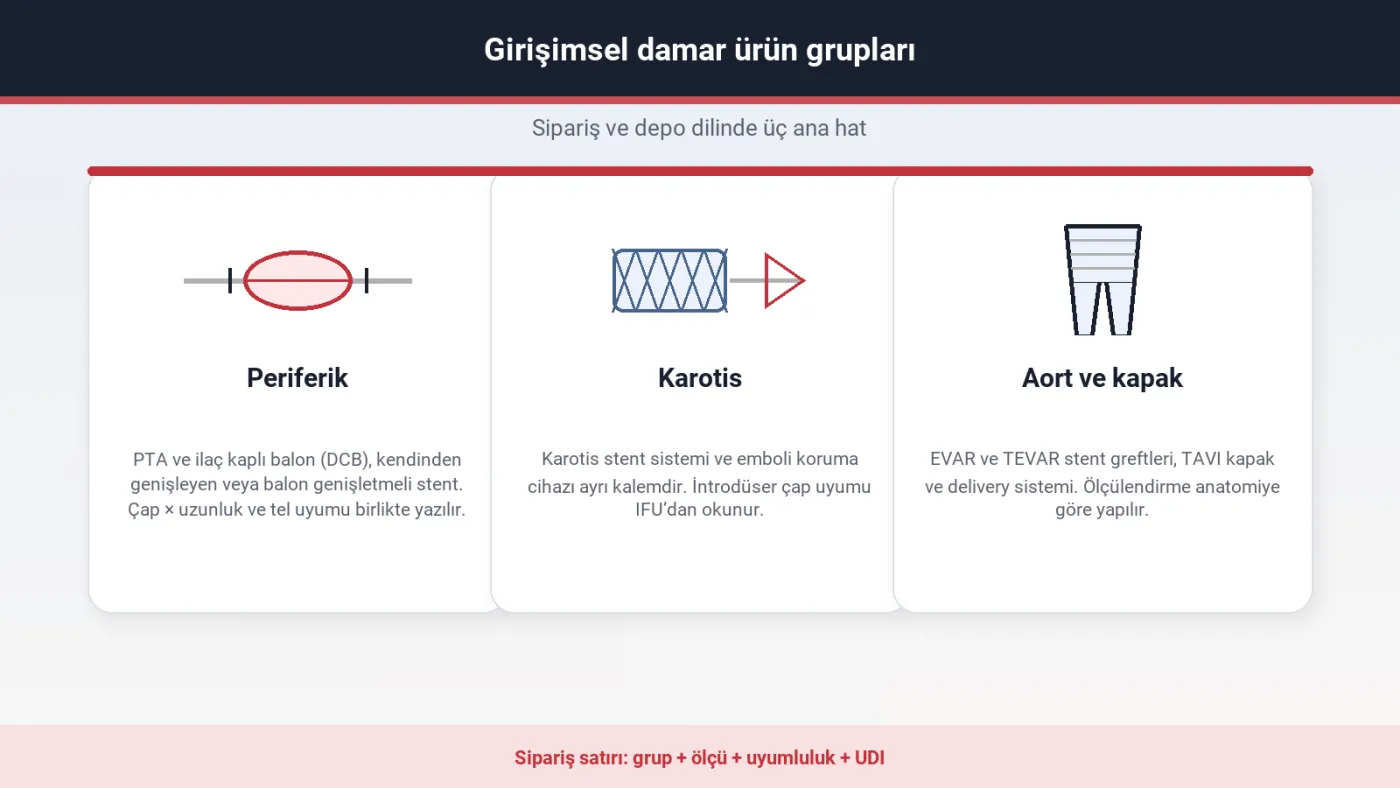
IFU revision date and version number are checked at every delivery. If a lot in stock carries an accessory list incompatible with an older revision, the procedure plan may change. When a digital IFU link exists, access date and language version are recorded. The angioplasty product groups article notes that the IFU should be reviewed before the order details for peripheral balloon, stent, and graft line items.
UDI: lot, serial number and barcode
UDI (Unique Device Identification) is the regulatory and logistics identity of a medical device. Under EU MDR and FDA UDI rules, device identifier (DI) and production identifier (PI) components are carried on the label via barcode or RFID. On the hospital side, practical review comes down to these fields:
- Lot / batch — the same production lot; recalls and stock rotation run on this number.
- Serial number — individual identity for single-use or serial-traced devices.
- Expiry date — checked in the warehouse and before clinical use for sterile products.
- GTIN / barcode — SKU matching in warehouse automation and the hospital information system.
UDI answers “which product arrived?” at lot level. Lot tracking and recall scenarios for sterile dressings are a separate heading; in wound-dressing evaluation, label checking is also part of the checklist in before choosing a wound product. For exosome and biologic-derived products, batch consistency and cold-chain records are kept in a separate section of the technical file; the assessment criteria are summarised in exosome technical file.
UDI checks at warehouse delivery
At delivery acceptance, barcode scanner, label, order line, and physical packaging are matched as a triad. Saying “same product family” is not enough to mix items of different diameter or length. If carotid and peripheral stents share a shelf in interventional stock, lot separation is critical for traceability. Near-expiry lots are used first (FEFO) in line with institutional policy.
CE marking and the regulatory context
The CE mark indicates that the manufacturer has assessed the device against the relevant EU legislation (MDR 2017/745 for most active and sterile devices) and completed the conformity process. Beside the CE mark on the label, a notified body number (for example CE 0123) may appear; that number shows which conformity assessment body was involved.
On the purchasing side, CE marking should be understood as a “declaration of regulatory conformity,” not a “quality approval.” Device class (I, IIa, IIb, III) sets the risk profile and the depth of the technical file; Class IIb interventional implants and Class I low-risk consumables are not compressed into the same checklist. For imported products, manufacturer and European representative addresses are sought on the label; missing address information can delay delivery.
Compression stockings and graduated bandages are classified as Class C medical devices; that term must not be confused with CEAP clinical stages. Pressure class and the sizing table appear in the IFU; detail is summarised in compression pressure (mmHg).
Label: sterility, symbols, and packaging layers
A medical device label contains a great deal of information in a small space. ISO 15223 series symbols are common: sterile, single use, expiry date, manufacturer, lot, caution. Labels are checked at three levels:
- Outer carton — logistics and warehouse identity; multipack count.
- Inner packaging — sterile barrier; damage or moisture indicator check.
- Device or small label — diameter, length, and UDI to be read during the procedure.
Even for non-sterile dressings, lot and expiry are kept for traceability. For antimicrobial coverings and moisture-balance products, indications and wear time in the IFU are more detailed than the short text on the label. Wound care categories are listed at category level on the wound care page; the technical file may bring a separate IFU set for each category.
Purchasing checklist
Technical file review runs in two stages: before order and after delivery. The list below is a general B2B checklist; institutional procedures may expand it.
- Indication and anatomic region — does the intended use on the order line match the IFU?
- IFU revision and language — is the latest version available in English or in a language the institution accepts?
- CE mark and class — is regulatory information complete on the label and in the IFU?
- UDI components — do lot, serial, expiry, and barcode match the order?
- Sizing and compatibility — are diameter, length, wire compatibility, and sheath diameter clear in the table?
- Sterility and storage — for sterile products, packaging integrity; are temperature and humidity conditions compatible with the warehouse?
- Recall and FSCA — are manufacturer safety notices or field safety corrective action emails being tracked?
- Training and technical support — is there a clinical training record for a new device or revision?
The interventional product portfolio is summarised at category level on the angioplasty page; dimensions and compatibility are covered in detail in reading sizes in interventional products. In the longevity and vascular health context, product selection remains bounded by clinical indication; the broader healthy lifespan discussion is covered separately on the longevity page.
Frequently confused terms
“Technical file” and “spec sheet” are not the same. A spec sheet summarises dimensions and materials; the IFU covers use, warnings and contraindications. The phrase “CE certificate” is sometimes confused with the declaration of conformity; purchasing usually proceeds from the label and IFU. A delivery with “no lot number” should not be accepted even in institutions without a formal traceability procedure.
In VascularVita supply discussions, technical file and IFU access are addressed together with logistics and training. The review order is agreed before products are compared; missing documents are completed or an alternative lot is planned. That discipline keeps the clinical team and the warehouse aligned on “right product, right patient, right time”.
Sources
- Regulation (EU) 2017/745 on medical devices (MDR). EUR-Lex
- ISO 13485:2016 — Medical devices — Quality management systems. iso.org
- ISO 15223-1:2021 — Symbols to be used with information supplied by the manufacturer. iso.org
- IMDRF UDI Guidance — Unique Device Identification of Medical Devices. imdrf.org
- VascularVita product scope: Angioplasty · Wound care · Exosome technical file · Longevity