In compression products, the “which stocking?” question often starts with an mmHg number. Pressure grade alone is not enough. Clinical stage, vascular anatomy, arterial perfusion, and patient adherence must be assessed together. This article summarises graduated medical compression (Class C) pressure classes, their relationship to ABPI.
Class C: what medical compression means
In Europe, graduated-pressure stockings and bandages are assessed under Class C in medical device classification. “Class C” must not be confused with CEAP clinical stages C0–C6: one is a regulatory class, the other a clinical finding scale. When an order form says “Class C stocking,” a medical graduated product is usually intended; it is not the same category as cosmetic or sports stockings.
In a medical compression product, pressure is expressed as a defined nominal value at the ankle (point B) and decreases proximally. The manufacturer IFU states the anatomic measurement point; an “18–21 mmHg” range is a class band, not a single number. Labelling stock only as “moderate pressure” may not match the class the clinical team expects.
Product groups and category-level information appear on the compression page. For the clinical terminology of chronic venous disease, the C0–C6 table in CEAP classification should be reviewed first.
Pressure grades (mmHg)
International practice commonly uses four main classes. Fractional numbers may vary by brand and country; full class name and mmHg range are written together on orders.
- Class I — approximately 18–21 mmHg: light graduated pressure; may be considered, on physician advice, in mild varicose or oedema profiles.
- Class II — approximately 23–32 mmHg: moderate pressure; the class band most often ordered in chronic venous insufficiency.
- Class III — approximately 34–46 mmHg: high pressure; in marked oedema, lipodermatosclerosis, or the period before venous ulceration, with appropriate patient selection.
- Class IV — approximately 49 mmHg and above: very high pressure; requires specific indication and close follow-up; stock policy is held separately within the institution.
In bandage systems, pressure works differently from stockings: layer count, elasticity, and application technique determine nominal mmHg. If “short stretch” and “long stretch” bandages share a shelf, lot and IFU separation is required for traceability. On intermittent pneumatic devices, pressure programme and duration are not mapped directly to stocking class.
ABPI and contraindication summary
A compression product applies external pressure to the leg to reduce venous oedema. If arterial perfusion is inadequate, the same pressure may impair circulation. Many guidelines therefore recommend ankle–brachial pressure index (ABPI) or equivalent arterial assessment, especially at higher classes.
ABPI is the ratio of ankle systolic pressure to arm pressure. In practice, threshold values are set in line with institutional policy and guidelines; a single value is not applied to every patient. In calcified vessels and some special situations the index can be misleading; toe–brachial index or vascular consultation then comes into play.
Situations that require attention when a compression product is considered:
- Severe peripheral artery disease or suspected critical limb ischaemia — arterial circulation is assessed before compression.
- Congestive heart failure — fluid load and oedema management are planned together.
- Active skin infection or wet wound — dressing and pressure plan must align with the wound team.
- Allergy or intolerance — latex, silicone band, or knit material; alternative products may be stocked.
- Severe peripheral neuropathy — assessing adherence and pressure sensation becomes harder; follow-up is intensified.
Arterial and venous pathology can coexist in the same leg. When critical ischaemia and wound intersect, the clinical approach is summarised in vascular health and healthspan. Perfusion questions in dressing selection start with the notes in wound dressing assessment.
Linking CEAP stage to compression pressure
CEAP clinical class (C0–C6) does not map one-to-one to compression class (I–IV). In the same C4 patient, oedema severity, presence of ulcer, and arterial status change selection. The summary below provides common terminology for the clinical team and for patient education.
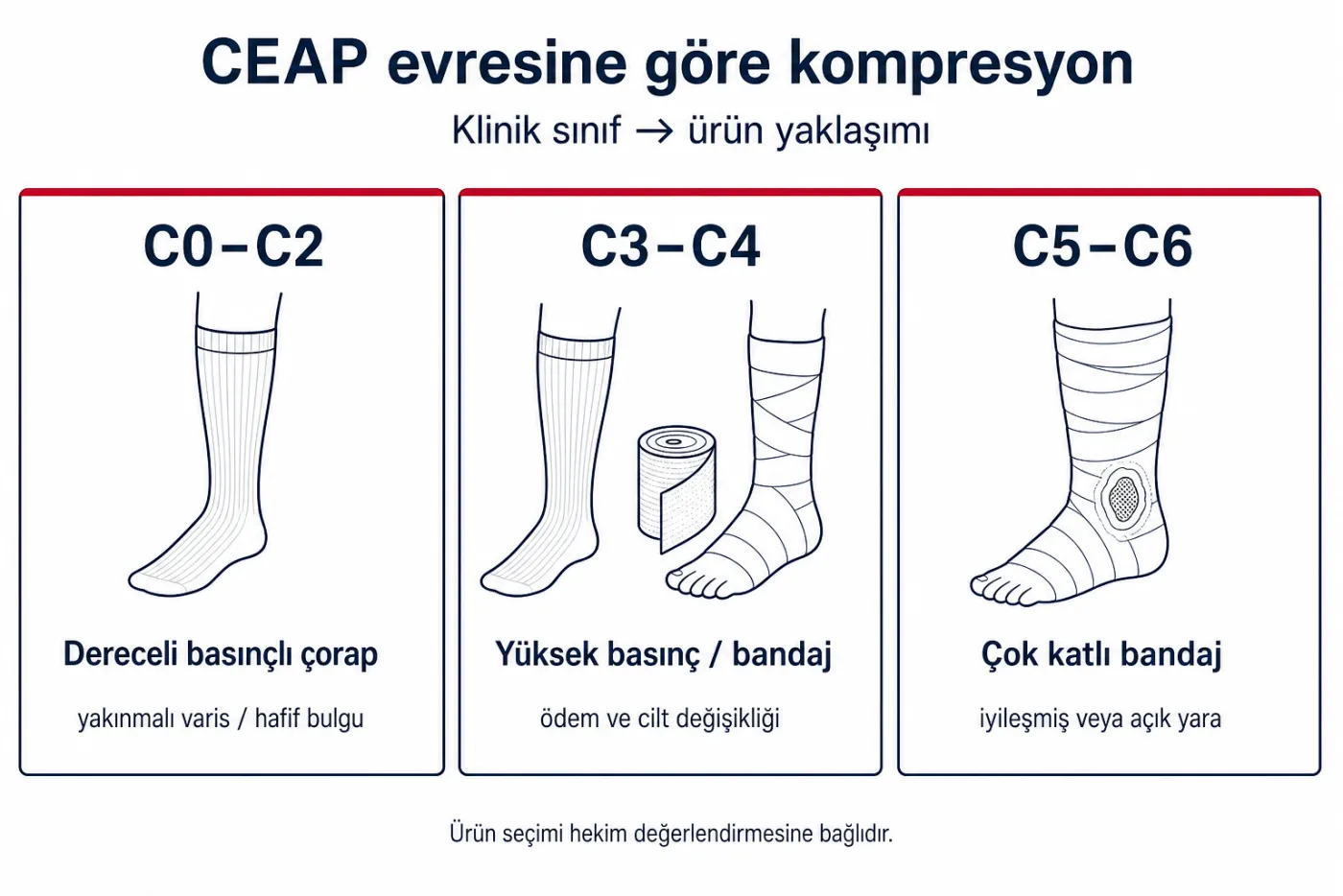
- C0–C1 — compression often is not considered, or a light class on physician advice.
- C2 — varicose veins; Class I or II is often considered; occupation and symptoms matter.
- C3 — oedema; typically Class II; ABPI and adherence follow-up.
- C4 — skin change (pigmentation, lipodermatosclerosis); Class II or III; skin care in parallel because of ulcer risk.
- C5–C6 — healed or open venous ulcer; multilayer bandage or high-class stocking; wound and vascular plans together.
In a C4 venous disease scenario, the priority headings — oedema, infection, dressing, and pressure sequence — are addressed separately in later scenario articles. Compression need after endovenous laser is asked together with medical laser wavelength and the venous treatment plan; post-EVLA duration and class follow institutional protocol.
Patient adherence
Application success depends on patient adherence. Daytime wear, loss of elasticity after washing, and a change in size set the time for renewal. A “one pair per year” assumption does not hold for every patient.
Education must not imply that “higher mmHg is always better”; appropriate selection depends on the clinical picture.
In lymphoedema and complex oedema profiles, compression, wound care, and mobilisation are planned together. Dressing categories are on the wound care page; venous anatomy and stage definitions are summarised in CEAP. Portfolio-level product groups can be followed from the compression page.
Sources
- De Maeseneer MG, et al. European Society for Vascular Surgery (ESVS) 2022 Clinical Practice Guidelines on the Management of Chronic Venous Disease of the Lower Limbs. Eur J Vasc Endovasc Surg. 2022. doi:10.1016/j.ejvs.2021.12.024
- Partsch H, et al. Indications for medical compression stockings in venous and lymphatic disorders: An evidence-based consensus statement. Phlebology. 2018. doi:10.1177/0268355516689631
- Lurie F, et al. The 2020 update of the CEAP classification system and reporting standards. J Vasc Surg Venous Lymphat Disord. 2020. doi:10.1016/j.jvsv.2019.12.075
- International Consortium on Compression Therapy. Compression therapy: a position document on compression therapy. EWMA position document
- VascularVita product scope: Compression product groups · CEAP classification