In endovenous laser ablation (EVLA), device wavelength determines in which tissue energy converts to heat; fibre type shapes how that energy spreads inside the vein. On the same 1470 nm platform, a bare-tip fibre and a radial fibre change the heat profile reaching the vein wall. This article summarises the clinical characteristics of bare, jacketed, and radial fibres and how they relate to medical laser wavelength selection.
Fibre tip and energy distribution
In EVLA, laser energy is delivered through an optical fibre placed inside the vein. Energy spreads from the fibre tip into the lumen and wall; endothelium and media are injured by controlled heat, and the vein closes fibrotic over time. Three variables are considered together in this process:
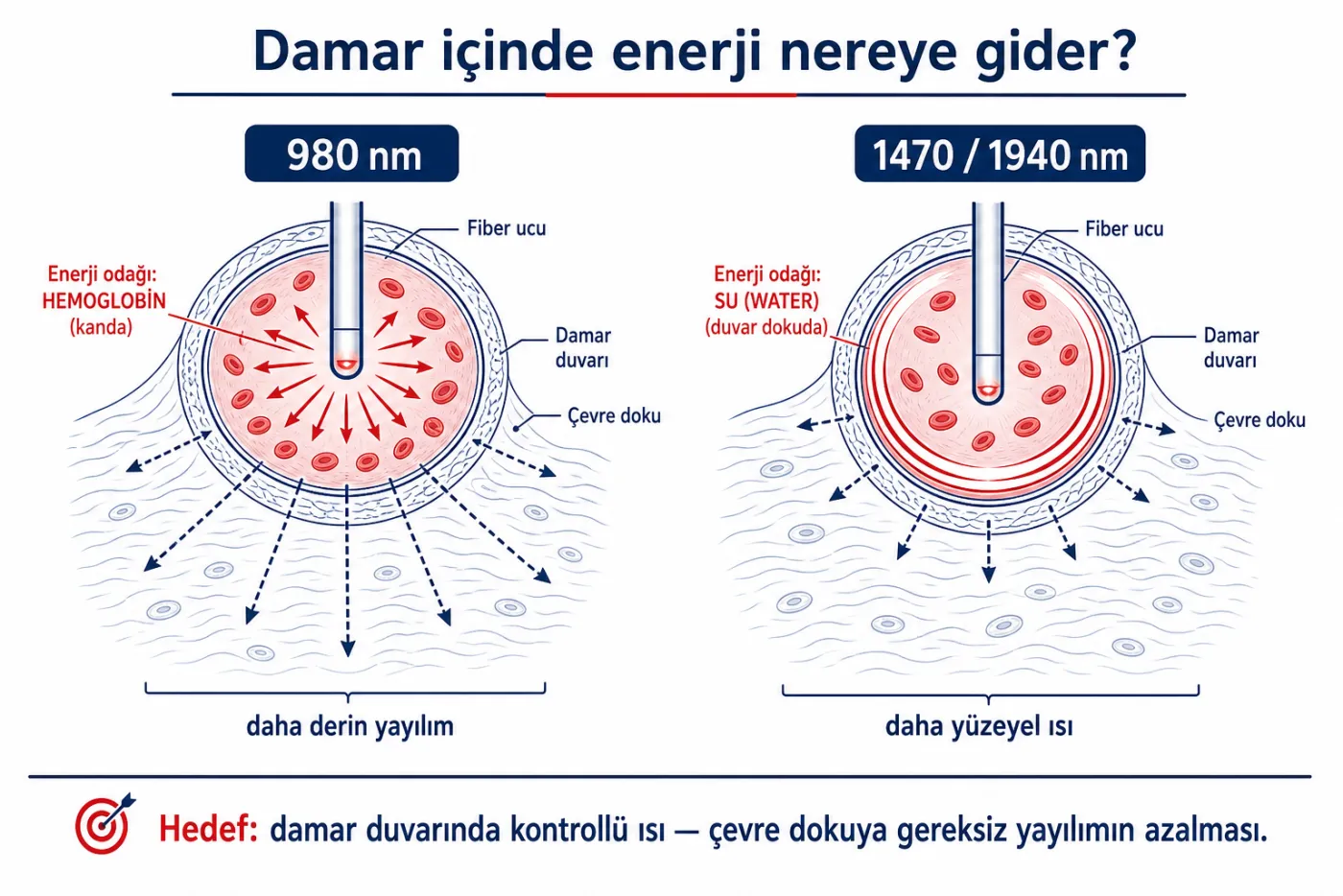
- Wavelength (nm) — target chromophore: haemoglobin or water? At shorter wavelengths heat forms more via blood; at longer wavelengths it forms near the fibre tip.
- Power (watts) and energy density (J/cm, LEED) — total heat dose along the vein; adjusted with pullback speed.
- Fibre tip geometry — bare, jacketed, or radial; sets the distribution angle of light into lumen and wall.
Vein diameter and wall thickness also affect dose planning. A thin-walled perforator and a thick-walled great saphenous vein may respond differently to the same fibre–wavelength combination. Ultrasound guidance and tumescent anaesthesia are part of procedural safety; fibre selection is assessed in that context.
Bare fibre
Bare-tip fibre (bare-tip, naked tip) transmits laser light forward at the fibre end without an added diffuser. The beam is narrow and forward-directed; energy concentrates immediately ahead of the tip. This combination has historically been common at shorter wavelengths (for example 810–980 nm).
Clinical assessment covers these headings:
- Heat density — narrow beam, high local heat; pullback speed and power setting are planned carefully for the same closure.
- Perforation risk — in thin-walled segments, energy dose and pullback speed are assessed together.
- Early-period profile — literature has reported higher early pain and bruising with short-wavelength + bare-fibre combinations; protocol is standardised within the institution.
Bare fibre is also used on some platforms for haemorrhoid laser or superficial vessel applications; outside EVLA indications, fibre diameter and tip design are catalogued differently. On orders, “bare fibre” must not be confused with radial or jacketed alternatives.
Jacketed fibre
Jacketed fibre has the tip partly or fully covered by a protective jacket. The aim is to let light exit only from a defined segment and to control energy distribution. Jacket material and aperture geometry vary by brand; the IFU states which segment is active.
Jacketed design in practice:
- Controlled emission zone — energy is delivered along the fibre or from a limited area at the tip; the heat map differs from a fully open bare tip.
- Pullback protocol — active segment length must align with pullback step and speed; otherwise unclosed zones may remain between segments.
- Platform compatibility — jacketed fibre is listed with specific generators and connectors; diameter and connector type are written on the order line.
“Jacketed” does not always mean radial fibre. Some manufacturers offer intermediate designs in a jacketed category; the tip cross-section and the emission angle should be checked together.
Bare or jacketed fibre: which to choose?
Radial fibre
Radial fibre (radial emitting, side-firing) spreads laser light around the circumference — towards the vein wall — rather than along the fibre axis. A prism, microscopic angled surface, or diffuser element at the tip directs the beam laterally at 360° or a defined angle. Radial fibre is widely preferred at longer wavelengths (especially 1470 nm and water-absorbing bands).
Clinical logic of radial design:
- Heat near the vein wall — at water-absorbing wavelengths energy stays near the tip; radial spread distributes more evenly around the wall.
- Energy dose — the same LEED value as with bare fibre can produce a different clinical result; protocol is defined in a separate table for radial fibre.
- Closure and early period — comparative studies of 980 nm bare fibre versus 1470 nm radial fibre have reported different early-period profiles; long-term closure rates depend on protocol.
Tip damage (carbonisation) on a radial fibre means the fibre has to be replaced. A bare tip and a radial tip are not interchangeable in the same procedure record.
Wavelength and fibre: considered together
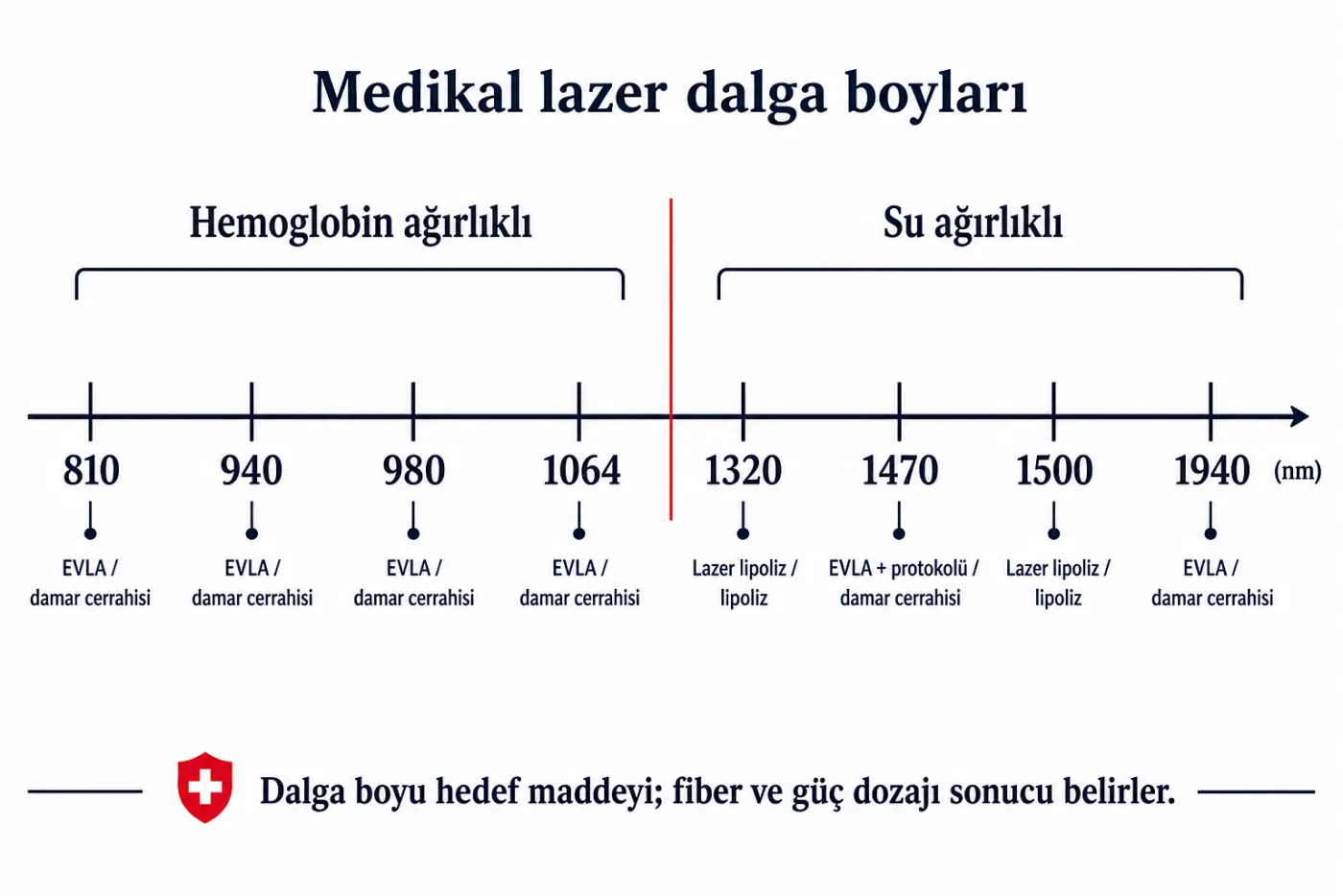
Fibre type is not considered apart from wavelength selection. When haemoglobin absorption dominates at shorter wavelengths, a forward bare-fibre beam targets blood inside the vein. When water absorption dominates at longer wavelengths, radial fibre provides more controlled spread around the wall. Medical laser wavelengths covers the 810–1940 nm band and absorption logic in detail; this article completes the fibre geometry layer.
Practical pairing summary (category level, brand-independent):
- 810–980 nm + bare fibre — historical EVLA protocols; high energy dose and pullback speed are set carefully.
- 1470 nm + radial fibre — a combination often seen in current EVLA practice; low–moderate LEED range by protocol.
- 1940 nm + radial or specialty tip — highly localised heat; power is kept low in thin-walled veins.
Product scope and category information appear on the medical laser page. Compression need after EVLA continues the venous treatment plan; pressure class and duration follow institutional protocol — compression pressure (mmHg) summarises the relationship between CEAP stage and ABPI. For clinical classification of chronic venous disease, see CEAP classification.
Sources
- van den Bos RR, et al. Endovenous laser ablation (EVLA): mechanisms and modeling. Lasers Med Sci. 2014. doi:10.1007/s10103-013-1480-5
- Doğancı S, Demirkılıç U. 980 nm bare-tip vs 1470 nm radial fibre. Eur J Vasc Endovasc Surg. 2010. doi:10.1016/j.ejvs.2010.04.006
- Cowpland CA, Cleese AL, Whiteley MS. Optimal linear endovenous energy density for EVLA — clinical evidence review. Phlebology. 2017. doi:10.1177/0268355516648067
- Keo HH, et al. 1940-nm water-specific wavelength for saphenous ablation. J Vasc Surg Cases Innov Tech. 2023. doi:10.1016/j.jvscit.2023.101125
- VascularVita: Medical laser · Wavelengths · Compression pressure