
In VascularVita longevity work, the aim is not to reverse chronological age. The aim is to protect the years in which a person can walk, decide, and sustain daily life — healthspan. Ageing is not reduced to a single test. Cellular and molecular decline, organ-system change, a person’s intrinsic capacity and daily function form a single continuum. Management follows from this assessment: define the clinical picture, reduce risk, give indicated treatment and monitor.
At the cellular level, one of the antagonistic drivers in this continuum is cellular senescence: the cell becomes a senescent cell. In López-Otín and colleagues’ framework of the hallmarks of aging, this response is protective in the short term and harmful when it accumulates. Damage to the genome, telomeres, and mitochondria can trigger this pathway; this article explains how the cell stops dividing and keeps secreting. All nine hallmarks appear in the nine hallmarks of ageing; the programme is described in the ageing stages and in individual assessment.
What is a senescent cell?
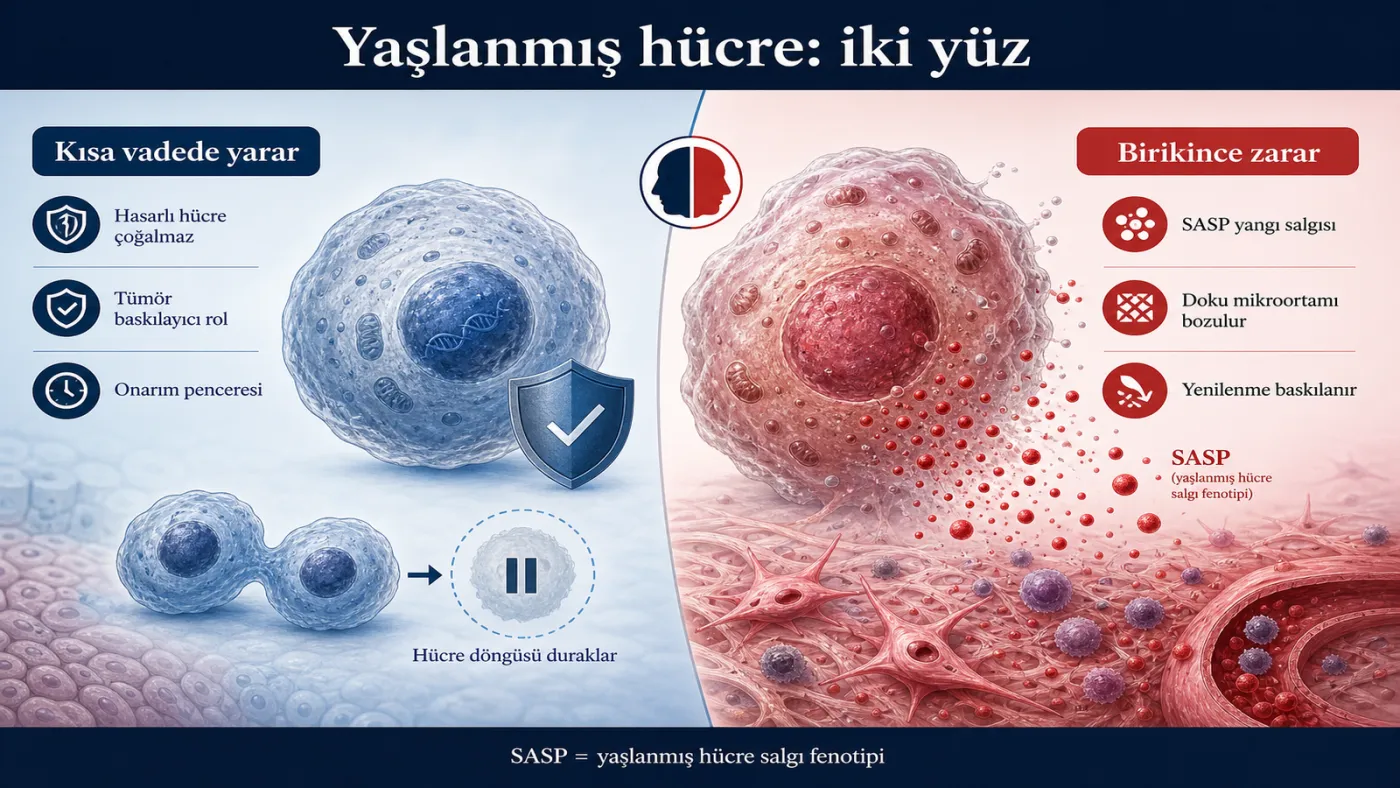
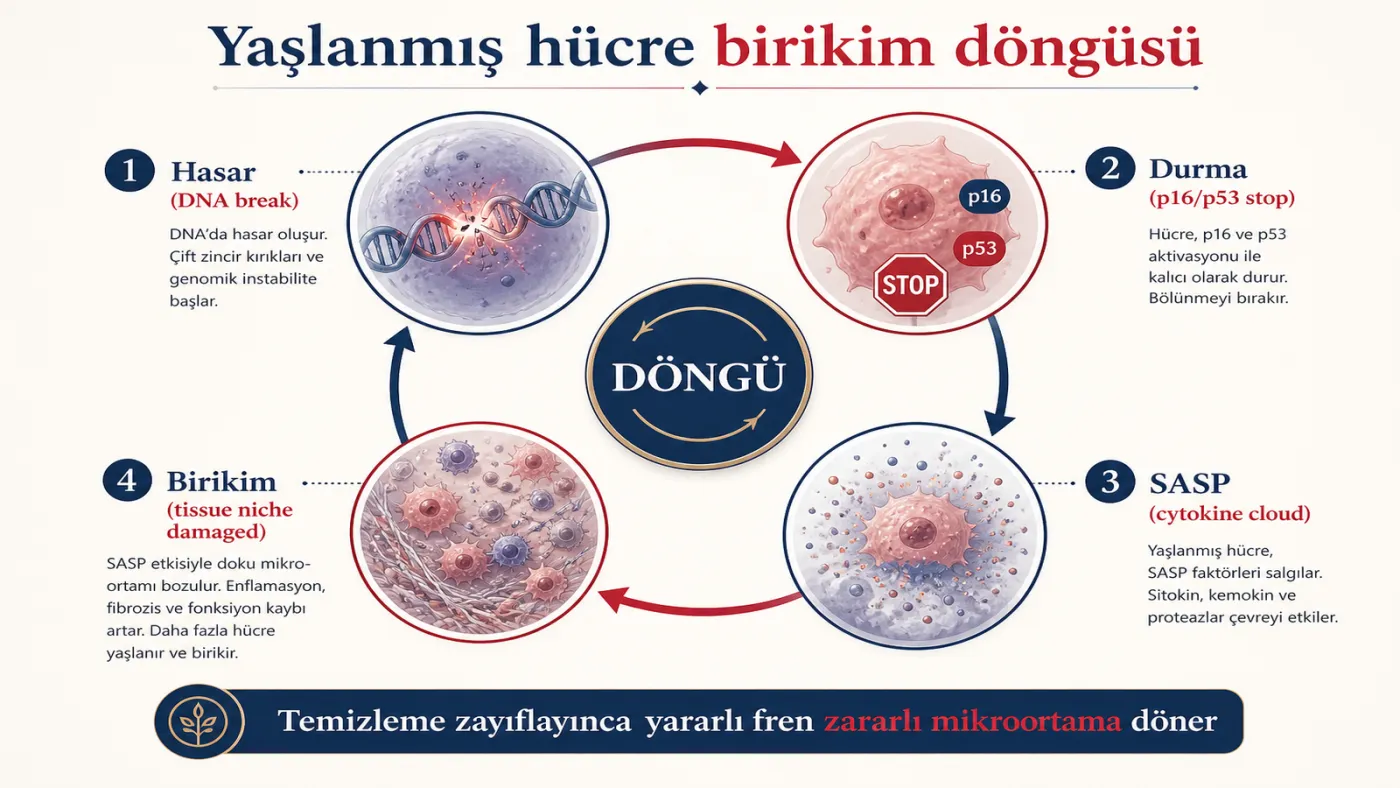
A senescent cell permanently stops dividing but does not die at once. This state differs from apoptosis: the cell remains in the tissue and can continue to secrete. Triggers include DNA damage, telomere stress, oxidant load, oncogene activation, and certain metabolic disturbances. The common pathway is often the DNA damage response (DDR); the p53 / p21 and p16INK4a / Rb pathways halt the cell cycle.
In the short term, this pause is tumour-suppressive: it limits expansion of a damaged genome. It can also play a temporary role in wound repair. The problem is that clearance and immune surveillance weaken with age. Senescent cells accumulate in tissue; as numbers rise, a useful “brake” becomes a harmful microenvironment (López-Otín 2023).
What is the SASP, and what does it do to tissue?
Accumulated senescent cells produce the senescence-associated secretory phenotype (SASP). This secretion includes cytokines, chemokines, growth factors, and matrix enzymes. The result is sterile inflammation, matrix remodeling, stress in neighbouring cells, and suppression of the stem-cell niche. The SASP thus links directly to stem cell exhaustion and intercellular communication; its inflammatory side overlaps inflammaging (Coppé et al., 2010).
Mitochondrial stress and the SASP can reinforce each other: energy impairment promotes the senescent-cell pathway; secretion also strains the mitochondrial milieu (Miwa et al., 2022). In a longevity assessment, senescent-cell accumulation is not a single “cell score”; its effects are sought at tissue and functional level.
Clinical face: fibrosis, joint, vessel
Clinical faces intersect idiopathic pulmonary fibrosis, osteoarthritis, diabetic kidney disease, atherosclerotic plaques, and some ocular complications. These belong to organ-specific disease management; they are not an “anti-ageing diagnosis.” The World Health Organization defines healthy ageing not as the absence of disease but as the preservation of functional ability; the same principle is developed in our article on healthspan.
In longevity management, a single “senescent-cell score” does not assign a stage. Walking, grip strength, pain–mobility limitation, and daily independence are functional proxies. Where organs are involved, management follows the relevant specialty guideline.
What can be done?
The most mature levers are exercise and metabolic balance. Movement and sound nutrition help reduce SASP load and the inflammatory base; sleep supports the same network. This topic overlaps with the articles on nutrient sensing and mitochondria.
In research, senolytics (candidates that selectively clear senescent cells; e.g., dasatinib + quercetin, fisetin) and senomorphics (approaches that suppress the SASP) are studied. Small human studies exist; early signals have been reported in diabetic kidney disease (Hickson et al., 2019). There is no general longevity indication. In local disease indications — for example, some ocular studies — the clinical research pathway is separate.
What is done in management?
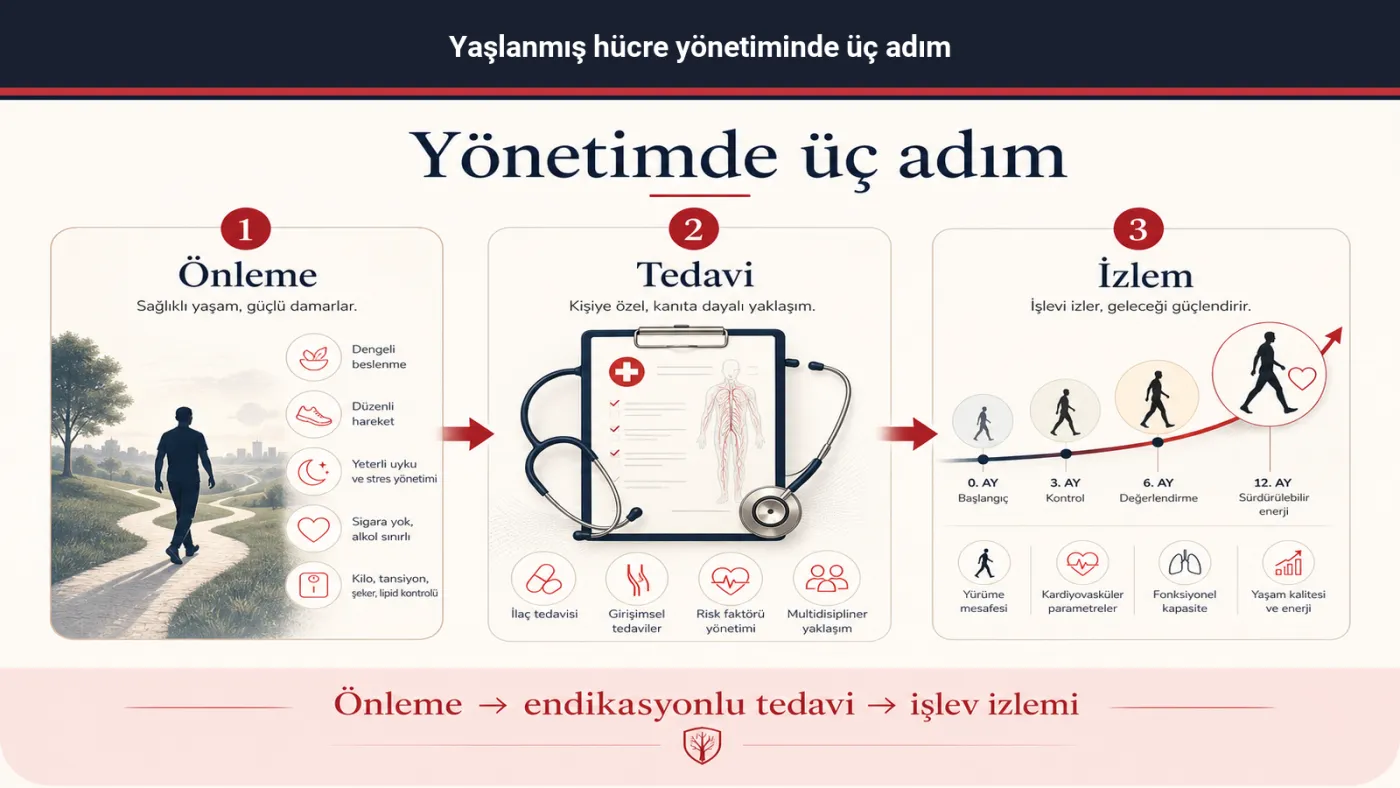
In the VascularVita approach, senescent-cell accumulation is addressed in three concrete steps.
First is prevention. Regular movement, sound nutrition, metabolic risk control, and sleep help limit SASP accumulation. The aim is not to “erase” a laboratory score; it is to delay inflammation and loss of function.
Second is disease-guided treatment. In fibrosis, joint, kidney, vascular, or ocular involvement, treatment follows the relevant guideline. Longevity screening assesses the ICOPE domains, frailty, and daily function together; it does not assign a stage from a single molecular “senescent-cell score.”
The third step is monitoring over time. Senescent-cell secretion is linked to inflammation and the stem-cell niche. That is why attention is not limited to a single laboratory result. The same person’s walking, grip strength, mobility capacity, and independence are reassessed at defined intervals. The flow is on the individual assessment and ageing stages pages.
Summary
Cellular senescence is an antagonistic hallmark of ageing defined by conversion of the cell into a senescent cell. It is protective in the short term; when it accumulates, the SASP disrupts tissue and affects the stem-cell niche and intercellular communication. The most mature intervention is exercise, sound nutrition, and the metabolic base. Senolytics and senomorphics are under research. In VascularVita longevity management, this hallmark is addressed through prevention, indicated treatment, and function-focused monitoring.
References
- López-Otín C, Blasco MA, Partridge L, Serrano M, Kroemer G. The hallmarks of aging. Cell. 2013;153(6):1194–1217. doi:10.1016/j.cell.2013.05.039 · PMC3836174
- López-Otín C, Blasco MA, Partridge L, Serrano M, Kroemer G. Hallmarks of aging: an expanding universe. Cell. 2023;186(2):243–278. doi:10.1016/j.cell.2022.11.001
- Coppé JP, Desprez PY, Krtolica A, Campisi J. The senescence-associated secretory phenotype: the dark side of tumor suppression. Annu Rev Pathol. 2010;5:99–118. doi:10.1146/annurev-pathol-121808-102144 · PMC2885946
- Hickson LJ, Langhi Prata LGP, Bobart SA, et al. Senolytics dasatinib and quercetin in diabetic kidney disease. EBioMedicine. 2019;47:446–456. doi:10.1016/j.ebiom.2019.08.069
- Miwa S, Kashyap S, Chini E, von Zglinicki T. Mitochondrial dysfunction in cell senescence and aging. J Clin Invest. 2022;132(13):e158447. doi:10.1172/JCI158447
- Kennedy BK, Berger SL, Brunet A, et al. Geroscience: linking aging to chronic disease. Cell. 2014;159(4):709–713. doi:10.1016/j.cell.2014.10.039 · PMC4852871
- World Health Organization. World report on ageing and health. Geneva: WHO; 2015. who.int
- Cesari M, Araujo de Carvalho I, Amuthavalli Thiyagarajan J, et al. Evidence for the domains of the WHO’s Integrated Care for Older People (ICOPE). J Gerontol A Biol Sci Med Sci. 2018;73(12):1653–1660. doi:10.1093/gerona/gly011
- Fried LP, Tangen CM, Walston J, et al. Frailty in older adults: evidence for a phenotype. J Gerontol A Biol Sci Med Sci. 2001;56(3):M146–M156. doi:10.1093/gerona/56.3.m146
Related articles
- Mitochondrial dysfunction: energy and ageing
- Stem cell exhaustion: the regenerative pool
- Genomic instability: DNA maintenance and ageing
- Telomere attrition: chromosome ends and ageing
- Altered intercellular communication
- The nine hallmarks of ageing
- Healthspan
- ICOPE and intrinsic capacity
- Frailty and early findings
- Healthy longevity · Ageing stages · Individual assessment