After endovenous laser ablation (EVLA), the first question from patients and clinical teams is often “For how long, and at what pressure?” The answer is not a single millimetre of mercury figure. The treated vein segment, the stage of coexisting chronic venous disease, the skin findings and the arterial circulation are all part of the same plan. The anonymised case below shows which questions shape the compression decision after EVLA.
Case summary
Patient: A 54-year-old woman in desk-based work. She has had varicose veins and a heavy feeling in the right leg for years. Over the past six months she has noticed evening swelling and darkening of the skin around the medial ankle. There is no rest pain and walking distance is not limited. She does not smoke; body mass index 31.
Imaging and classification: Duplex ultrasound shows reflux along the right great saphenous vein (GSV) in the thigh, diameter about 7 mm. The deep veins are patent. Clinical CEAP class C4a (pigmentation and oedema), primary aetiology (Ep), superficial anatomy (As), reflux (Pr). Ankle–brachial pressure index (ABPI) 1.02 on the right.
Procedure: EVLA of the right GSV under ultrasound guidance and tumescent anaesthesia. Wavelength, fibre type and energy delivered were written in the procedure record; those parameters are described in endovenous laser fibre types. The procedure was completed without complication, with review booked for one week.
Compression after EVLA: the questions that are asked
1. For how long?
The evidence is more limited than it is often assumed to be. In the randomised trial by Bakker and colleagues, patients who wore a stocking for 7 days after EVLA reported less pain and better physical function in the first week than those who wore it for 48 hours; by week six the groups no longer differed. In the 2022 meta-analysis by Hu and colleagues, compression after thermal ablation did not show a meaningful benefit for vein occlusion, complications or quality of life. Many centres therefore use a short course and set the duration from the patient’s symptoms.
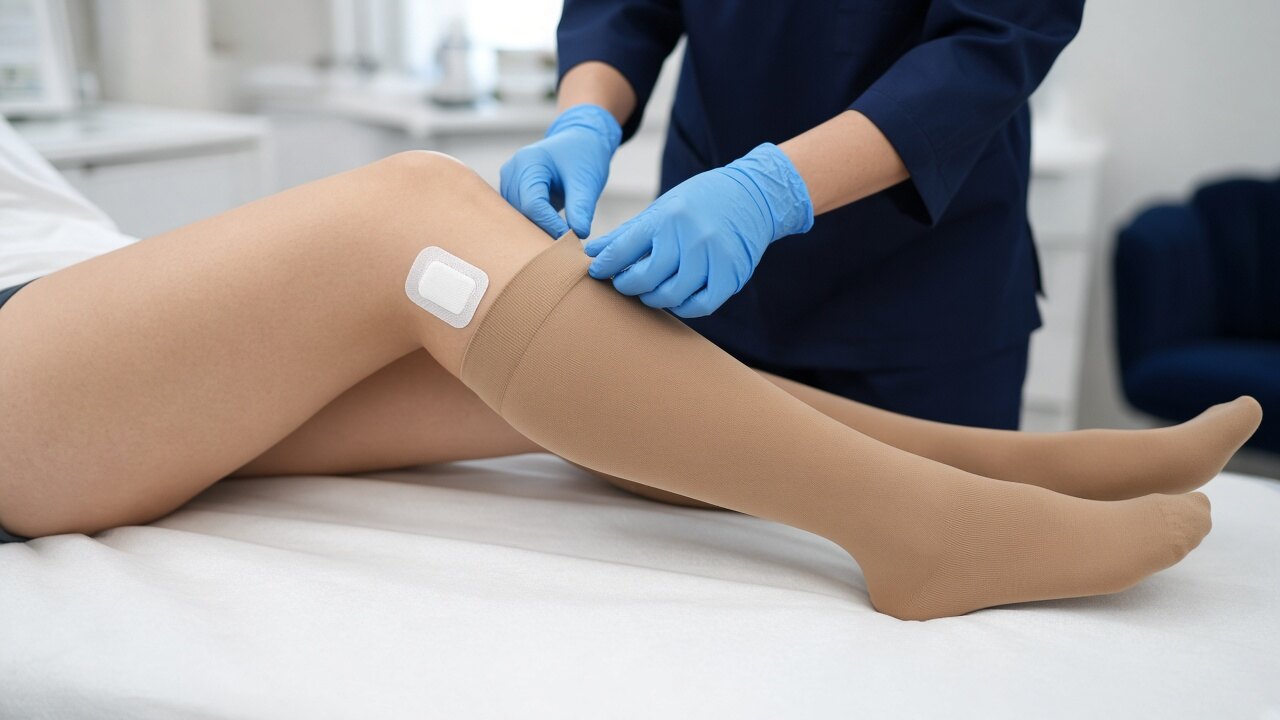
In this case the plan was daytime wear for the first week, then a decision at review. Because of C4a skin change and oedema, continuing daytime compression as long-term care of the chronic venous disease — separate from the post-procedure period — was discussed as well. Those two aims answer different questions: short-term compression after the procedure, and long-term compression in chronic disease.
2. Which pressure class?
When arterial circulation is adequate (here ABPI above 0.9), most protocols use a class II graduated medical stocking (about 23–32 mmHg). Some centres find class I sufficient in the post-procedure period. Pressure classes are described in compression pressure (mmHg), and selection by CEAP stage in compression planning by CEAP stage.
3. Stocking or bandage, and which length?
After EVLA most centres go straight to a graduated stocking; it is easier to put on, so adherence is better. When the GSV has been treated through the thigh, some centres prefer a thigh-length (AG) stocking because pain and bruising extend into the thigh; others find a below-knee (AD) stocking sufficient. The choice should be defined in the institutional protocol. For a patient who cannot manage a stocking, a short-stretch bandage is a temporary option; applying it at the intended pressure takes training.
4. Which adverse effects are watched?
The most common findings after the procedure are bruising, pain and firmness (induration) along the treated vein. Transient numbness can appear in segments close to the saphenous nerve. If compression causes pain, numbness, coldness or a colour change in the leg, it is reviewed at once. In a patient with C4 skin change, skin care under the stocking is planned with the wound team, watching for maceration.
5. Review and imaging
Many centres perform a duplex check within the first week. That study looks at occlusion of the treated vein, endovenous heat-induced thrombosis (EHIT) and deep-vein thrombosis. Compression duration is updated together with the ultrasound findings and the patient’s symptoms. Fibre type and energy parameters stay in the procedure record.
Planning compression and wound care together in C4 venous disease is described in C4 venous skin change and oedema.
Sources
- De Maeseneer MG, et al. ESVS 2022 Clinical Practice Guidelines on the Management of Chronic Venous Disease of the Lower Limbs. Eur J Vasc Endovasc Surg. 2022. doi:10.1016/j.ejvs.2021.12.024
- Bakker NA, et al. Compression stockings after endovenous laser ablation of the great saphenous vein: a prospective randomized controlled trial. Eur J Vasc Endovasc Surg. 2013. doi:10.1016/j.ejvs.2013.08.001
- Hu H, et al. No benefit of wearing compression stockings after endovenous thermal ablation of varicose veins: a systematic review and meta-analysis. Eur J Vasc Endovasc Surg. 2022. doi:10.1016/j.ejvs.2021.09.034
- Rabe E, et al. Indications for medical compression stockings in venous and lymphatic disorders: an evidence-based consensus statement. Phlebology. 2018. doi:10.1177/0268355516689631
- Lurie F, et al. The 2020 update of the CEAP classification system and reporting standards. J Vasc Surg Venous Lymphat Disord. 2020. doi:10.1016/j.jvsv.2019.12.075