Wound care in venous insufficiency often starts with “which dressing?” The clinical headings that have to be clear come before the dressing. CEAP classification provides the common terminology here. In the 2020 update, C4 is split into three subgroups: C4a pigmentation or venous eczema, C4b lipodermatosclerosis or atrophie blanche, and C4c a corona phlebectatica. C5 is a healed ulcer and C6 an active venous ulcer. The anonymised case below shows the order of questions, and how compression and wound care are planned together, in a patient with C4 oedema and superficial skin damage.
Case summary
Patient: A 71-year-old woman with obesity and hypertension, and no diabetes. For years she has described a heavy feeling in the legs and swelling that increases in the evening. In recent months she has developed itching, darkening of the skin and a small superficial break around the medial ankle. She used a previously recommended compression stocking irregularly because she found it uncomfortable.
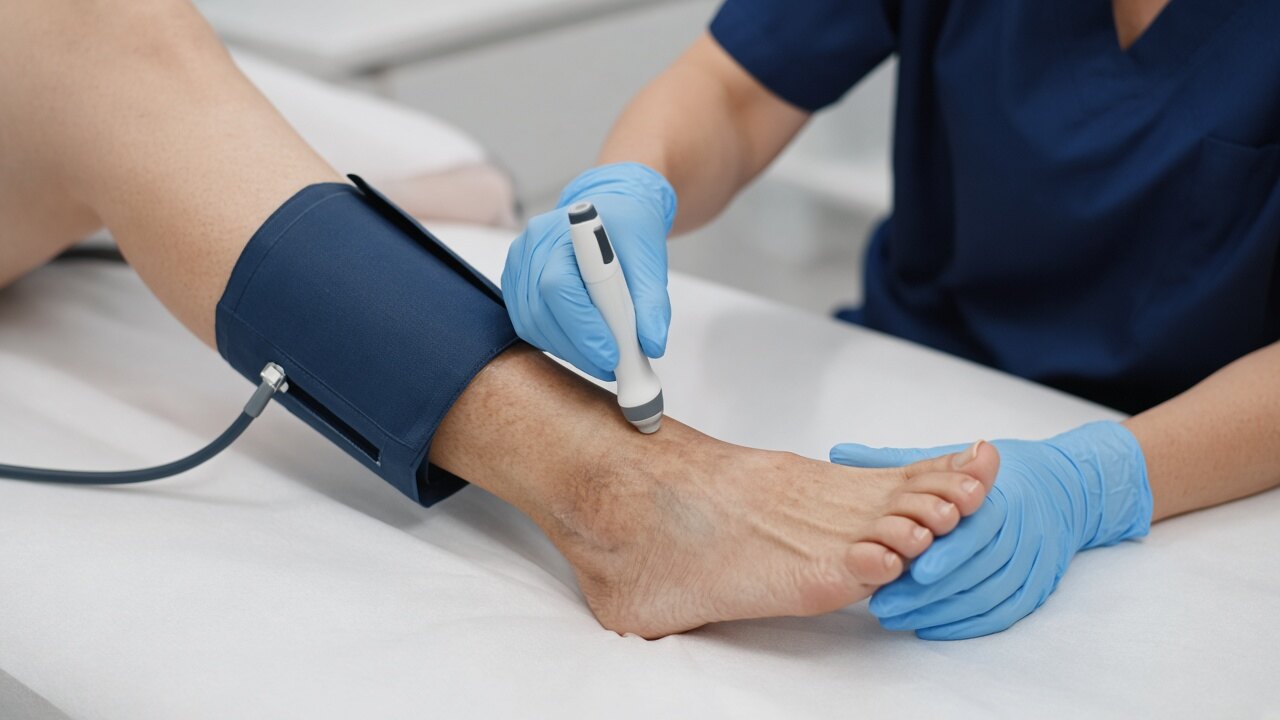
Examination: Hyperpigmentation and lipodermatosclerosis in the gaiter area, with moderate pitting oedema in both legs. A superficial, moist excoriation about 1.5 cm across over the medial malleolus; no necrotic tissue and no sign of deep infection. Foot pulses are palpable. ABPI 1.0 on the right and 0.95 on the left.
Duplex ultrasound: Great saphenous reflux in both legs; deep veins patent, no sign of thrombosis.
Coding: Clinical class C4b (lipodermatosclerosis and oedema), primary aetiology (Ep), superficial anatomy (As), reflux (Pr). There is no open venous ulcer (C6), but the skin barrier is weakened and the risk of ulceration is high.
Four priority headings
1. Arterial circulation
Compression is the basis of treatment for venous oedema. If arterial inflow is inadequate, the same pressure can also restrict blood flow to the tissue. In this case ABPI is above 0.9 in both legs, so standard compression can be started. In diabetes, kidney failure or calcified vessels, ABPI can read falsely high; toe–brachial index (TBI) or further imaging is then required. The combination of arterial and venous disease is described in perfusion assessment in wound care.
2. Venous anatomy and the option of intervention
Duplex ultrasound shows which vein carries the reflux and the state of the deep system. The 2022 ESVS guideline recommends interventional treatment of superficial reflux in patients with C4–C6 disease. The EVRA trial showed that early endovenous ablation speeds healing in patients with ulcers. The patient is therefore referred for vascular surgical assessment; compression continues during that process and afterwards.
3. Infection or colonisation?
The superficial excoriation has no spreading redness, warmth, foul smell or necrotic tissue. The picture fits superficial colonisation and does not suggest deep soft-tissue infection. Systemic antibiotics are not required at this stage. Where the distinction between colonisation and infection is unclear, the findings in when to consider an antimicrobial dressing are used. An antimicrobial dressing is not routine for every patient with C4 disease.
4. Oedema control and the wound surface
In C4, oedema control is central to protecting the skin barrier and preventing ulceration. In most protocols the basic choice is a class II graduated compression stocking (about 23–32 mmHg). In marked oedema, or when a stocking cannot be put on, oedema is reduced first with a short-stretch bandage and the stocking follows. Pressure classes are described in compression pressure (mmHg), and selection by CEAP stage in compression planning by CEAP stage.
On a superficial, moist excoriation the aim is to keep moisture in balance and reduce friction. Before a dressing is chosen, exudate, the wound edge and the surrounding skin are assessed with the questions in questions before choosing a wound product. In venous eczema, care of the surrounding skin and barrier products are planned separately.
A sequential plan
The plan followed in this case (adapted to the institutional protocol):
- First two weeks: Oedema and skin care. Once oedema has fallen, measurements are taken for a class II stocking and daytime wear is the aim. A moisture-balance dressing on the excoriation, and a barrier product on the surrounding skin.
- Review: The fall in oedema, itching, healing of the excoriation and hours of stocking wear are recorded.
- Vascular surgical assessment: Endovenous treatment of great saphenous reflux is discussed.
- Deterioration: If the wound deepens, the class is updated to C6; multilayer compression bandaging and wound-team follow-up begin.
The compression plan after endovenous treatment is described in compression after EVLA.
Common errors
Treating C4 as mild varicose veins, and delaying oedema control and skin care, makes ulceration more likely. Starting compression without an ABPI is risky when arterial disease coexists. Changing dressings without duplex misses the underlying reflux. Support or sports stockings are no substitute for medical graduated compression. If the CEAP class in the record is not updated, follow-up no longer matches the patient.
Sources
- Lurie F, et al. The 2020 update of the CEAP classification system and reporting standards. J Vasc Surg Venous Lymphat Disord. 2020. doi:10.1016/j.jvsv.2019.12.075
- De Maeseneer MG, et al. ESVS 2022 Clinical Practice Guidelines on the Management of Chronic Venous Disease of the Lower Limbs. Eur J Vasc Endovasc Surg. 2022. doi:10.1016/j.ejvs.2021.12.024
- O’Donnell TF Jr, et al. Management of venous leg ulcers: clinical practice guidelines of the Society for Vascular Surgery and the American Venous Forum. J Vasc Surg. 2014. doi:10.1016/j.jvs.2014.04.049
- Gohel MS, et al. A randomized trial of early endovenous ablation in venous ulceration (EVRA). N Engl J Med. 2018. doi:10.1056/NEJMoa1801214
- Rabe E, et al. Indications for medical compression stockings in venous and lymphatic disorders: an evidence-based consensus statement. Phlebology. 2018. doi:10.1177/0268355516689631