Ageing is the progressive loss of an organism’s physiological integrity over time. Function declines; age is a major risk factor for cancer, diabetes, cardiovascular disease, and neurodegenerative disease.
In the 2013 Cell review The Hallmarks of Aging, López-Otín and colleagues proposed defining mammalian ageing through shared cellular and molecular processes. The full text is available via PMC3836174. In 2023 the authors discussed additional candidate hallmarks. This page summarises the framework. Detailed articles for each hallmark are listed below.
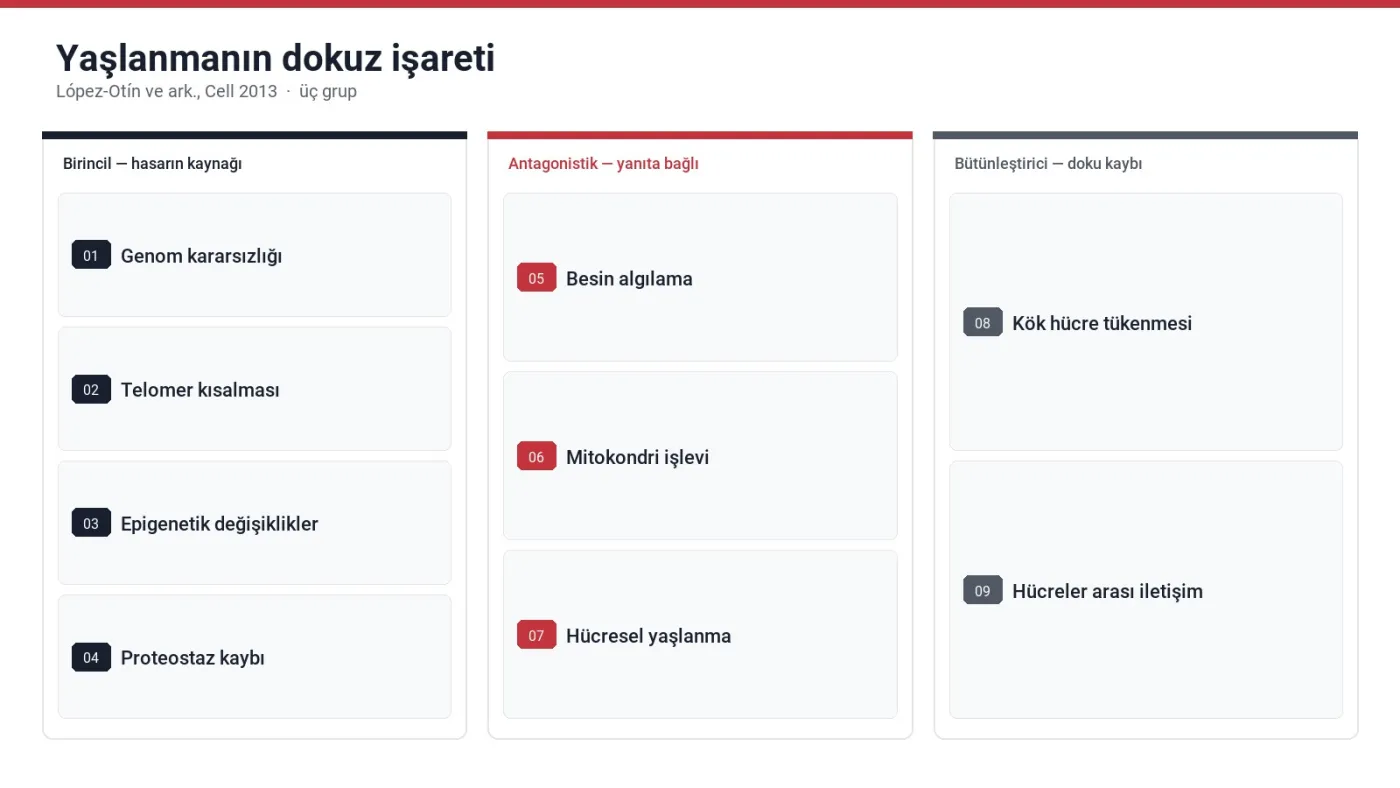
Criteria and classification
For a process to count as a hallmark of ageing, three criteria are sought: it appears during normal ageing; experimentally aggravating it accelerates ageing; improving it contributes to healthspan. The strength of evidence is not equal across hallmarks.
The nine hallmarks are divided into three groups. Primary hallmarks are the source of damage. Antagonistic hallmarks are responses to damage; at low levels they may be protective, and when high or chronic they may become harmful. Integrative hallmarks reflect loss of tissue and organ function.
Primary
Genomic instability
DNA is under continuous damage risk from external factors (radiation, chemicals) and internal processes (replication errors, oxidative stress). With age, somatic mutations, chromosomal aneuploidies, and copy-number changes accumulate. Mitochondrial DNA is affected alongside nuclear DNA; its repair capacity is limited. Progeroid conditions such as Werner and Bloom syndromes show that defects in DNA maintenance can produce an ageing phenotype. Nuclear lamina abnormalities (for example lamin A / progerin) also impair genome stability.
Primary
Telomere attrition
Telomeres at chromosome ends tend to shorten with each cell division; telomerase activity is low in most somatic cells. The shelterin complex protects telomeres from “repair” machinery; when protection fails, a DNA damage response, senescent-cell formation, or apoptosis can be triggered. In humans, telomerase or shelterin defects are linked to pulmonary fibrosis, aplastic anaemia, and dyskeratosis congenita. In mouse models, telomere shortening shortens lifespan; reactivating telomerase can reverse some early-ageing phenotypes.
Primary
Epigenetic alterations
DNA methylation, histone acetylation/methylation, and chromatin organisation govern gene expression without changing the DNA sequence. With age these marks drift: hypomethylation in some regions, hypermethylation in others; shifts in histone profiles. The result is mistimed gene expression and opening of silent genomic regions. Epigenetic clocks (DNA methylation patterns) are used to estimate biological age. Experimental manipulation of epigenetic regulators can accelerate or slow ageing phenotypes.
Primary
Loss of proteostasis
Proteostasis is the correct production, folding, trafficking, and clearance of proteins. Chaperones, the ubiquitin–proteasome system, and autophagy take part in this balance. With age, misfolded proteins and aggregates accumulate; this build-up is prominent in diseases such as Alzheimer disease, Parkinson disease, and cataract. Weakening of the heat-shock response and slowing of clearance pathways increase cellular stress. Loss of proteostasis interacts with other hallmarks (especially mitochondria and senescent-cell accumulation).
Antagonistic
Deregulated nutrient sensing
Cells sense nutrient and energy status through IGF-1 / growth hormone, mTOR, AMPK, and sirtuin pathways. In youth, anabolic signals are needed for growth and repair; with age, excessive or unbalanced signalling can increase metabolic stress. Caloric restriction and mTOR inhibition (for example rapamycin models) have been found to affect lifespan and healthspan in many organisms. This hallmark is “response-like”: short-term stimulation may help; chronic imbalance may harm.
Antagonistic
Mitochondrial dysfunction
Mitochondria produce ATP; they are also a source of reactive oxygen species (ROS). With age, respiratory-chain efficiency falls, mitochondrial DNA damage accumulates, and mitophagy weakens. Low-level ROS can act as signals; high and chronic oxidative stress increases protein, lipid, and DNA damage. Mice with defective mitochondrial DNA polymerase γ show an early-ageing phenotype. Energy deficit and inflammatory signals affect a wide range from vascular endothelium to muscle.
Antagonistic
Senescent cells
A senescent cell stops dividing; the p16INK4a / p53 pathways and the DNA damage response take part in this state. In the short term it can be tumour-suppressive and aid wound repair. With chronic accumulation, the senescence-associated secretory phenotype (SASP) releases cytokines, growth factors, and proteases that disrupt inflammation and tissue remodeling in neighbouring tissue. Senescent-cell burden rises in aged tissues; experimental clearance (senolytic approaches) can improve function in animal models.
Integrative
Stem cell exhaustion
Tissue renewal depends on adult stem and progenitor cell pools. With age, both number and function of these cells decline: anaemia and immune weakness in the haematopoietic system; reduced repair capacity in muscle, skin, and intestinal epithelium are examples. Genomic damage, telomere attrition, epigenetic drift, and senescent-cell accumulation disrupt the stem-cell niche. The result is decline in tissue homeostasis and post-injury regeneration.
Integrative
Altered intercellular communication
Endocrine, neuroendocrine, and inflammatory signals change with age. Chronic low-grade inflammation (“inflammaging”), shifts in neuroendocrine axes, and disrupted paracrine communication via extracellular vesicles (including exosomes) fall under this heading. Weakened immune surveillance can raise infection and cancer risk. At the tissue level, a disrupted signalling network extends from the stem-cell niche to the vascular endothelium.
Nine hallmarks — individual articles
- Genomic instability
- Telomere attrition
- Epigenetic alterations
- Loss of proteostasis
- Deregulated nutrient sensing
- Mitochondrial dysfunction
- Senescent cells
- Stem cell exhaustion
- Altered intercellular communication
Interdependence of the hallmarks
The nine hallmarks are not independent. Genomic damage can trigger senescent-cell accumulation; senescent-cell secretion increases inflammation; inflammation disrupts the stem-cell niche; mitochondrial stress strains proteostasis. The 2023 update also discussed additional candidates such as disabled macroautophagy, chronic inflammation, and dysbiosis. Clinical and biological research aims not at a single “key,” but at resolving the relative weight of this network.
Vascular health
Endothelial dysfunction, arterial stiffness, oxidative stress, and low-grade inflammation are classic components of vascular ageing. When perfusion is impaired, organ reserve and wound healing are affected. That is why vascular integrity is a central physiological component in the healthspan discussion. For institutional information, see long and healthy life; for product scope, see stem cell and exosome.
Sources
- López-Otín C, Blasco MA, Partridge L, Serrano M, Kroemer G. The Hallmarks of Aging. Cell. 2013;153(6):1194–1217. DOI: 10.1016/j.cell.2013.05.039 · PMC3836174
- López-Otín C, Blasco MA, Partridge L, Serrano M, Kroemer G. Hallmarks of aging: An expanding universe. Cell. 2023;186(2):243–278. DOI: 10.1016/j.cell.2022.11.001
- Tartiere AG, Freije JMP, López-Otín C. The hallmarks of aging as a conceptual framework for health and longevity research. Frontiers in Aging. 2024;5:1334261. DOI: 10.3389/fragi.2024.1334261
- Ungvari Z, Tarantini S, Donato AJ, Galvan V, Csiszar A. Mechanisms of Vascular Aging. Circulation Research. 2018;123(7):849–867.
- World Health Organization. Decade of Healthy Ageing.
- Dr. Kadir Çeviker. Leg artery occlusion · What an exosome is and is not